
Nature and Nurture: How Genes and Environment Shape our Brain
November 19, 2025 2026-08-20 8:08Nature and Nurture: How Genes and Environment Shape our Brain
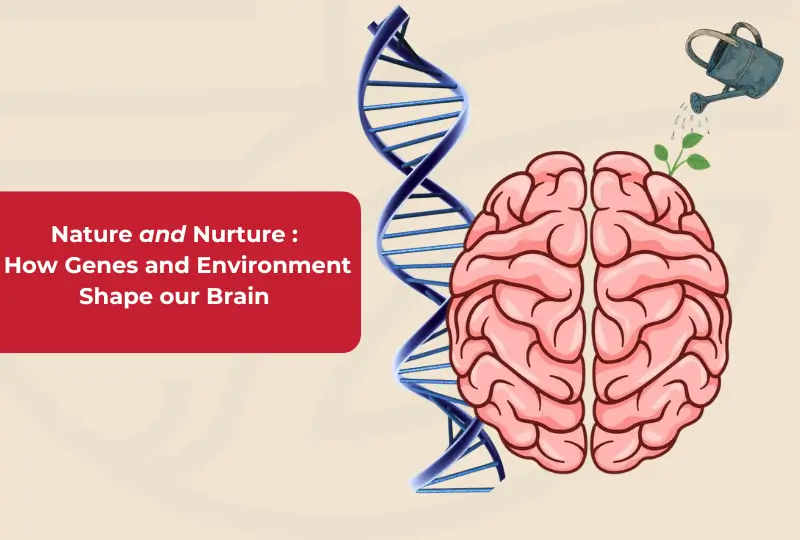
Nature and Nurture: How Genes and Environment Shape our Brain
Are we born with our minds as blank slates, waiting to be written by the world around us? Or do our genes—passed down from our parents—predetermine who we become and the life we live?
For decades, psychologists and neuroscientists have explored this timeless Nature vs Nurture debate. Years of research has shown: both our biology and our environment work together to shape our brain, influence behaviour, and guide overall development.
We understand that the genes passed down from our parents build the foundation of every cell in our body, but our environment also influences how these genes will behave. What could these environmental influences be? To name a few, nutrition, diet, stress, emotional environment, toxins & pollutants. These factors can ‘talk to your genes’ and shape which genes are active at different times, which can then aid in influencing brain development, immunity, stress response, behaviour, and overall health — without actually rewriting your DNA.
One of the classic and heavily researched examples of this is the – Dutch Hunger Famine of 1944-1945. The Dutch Famine took place in the German occupied Netherlands during World War II, leaving a lasting effect on the population who faced it and the generations to come. It was found that the birth weights of children in the womb of pregnant mothers who were malnourished were born small and weak. This is straightforward, as we know, a fetus requires proper nutrition for growth in the belly. However, what researchers didn’t expect to find was – when these same children went on to live their lives, where they had access to ample food and resources, they could never gain weight properly and continued to be weak and fragile. This tells us that this early life stress contributed to affecting the individual’s life for decades even when their environment had reverted to being normal.
The field of study examining this is called – Epigenetics. Epi means above, hence the literal meaning of the word being, ‘above the genes’. Environmental influences lead to certain modifications which sit ‘above the genes’ resulting in altering their functionality.
Another important aspect to look at is – Brain Development. Brain Development is far from being completed at birth, it is an ongoing process – with Nature and Nurture playing important roles along the way. Our brain, composed of neurons, is a dynamic organ. From birth till the age of 7, over 100 million new neural connections are being formed every second (10 x 107/second) , the connections not in use are destroyed over time. This constant wiring and re-wiring shape who we become. This is where our external environment, ‘Nurturing’ can play a major role. The modifications as a result of environmental influences to our genome during the critical period of development can lead to changes that might lay dormant and show up in later years of life. These are called- Epigenetic modifications or Epigenetic marks. These could be triggered by stress, improper diet and nutrition, less attraction with caregivers, negligible physical activity etc.
When the body experiences stress, it activates the stress-response system—the HPA axis (Hypothalamus–Pituitary–Adrenal)—which controls the release of cortisol, our primary stress hormone. Chronic or overwhelming stress can also leave these epigenetic marks on key genes that regulate this system, altering how cortisol is produced and secreted in our body. Research even suggests that some of these stress-related epigenetic marks can be passed down to the next generation, meaning offspring may inherit the effects without ever experiencing the original stressful environment.
At Navriti, the science of ‘Nurture’ isn’t an idea—it is built into the school itself. Every space, routine, material, and teaching practice has been intentionally designed for the early years, when the brain is most sensitive to stress, environment, and experience. While most schools focus on subjects, we focus on the wiring that makes learning possible.
Our classrooms regulate sensory load.
Our routines follow the brain’s natural rhythm.
Our teachers are trained to spot early emotional and cognitive signals.
Our Brain & Behaviour Team works with families so the nurturing continues at home.
This is Precision Schooling—where a child’s pace, attention cycles, emotional needs, and neural readiness shape how they learn every day.
Very few schools understand how deeply the early environment affects the brain. Even fewer design their entire model around it. At Navriti, your child’s most formative years are protected, personalised, and scientifically nurtured—giving them an advantage that simply cannot be recreated later.
Because when 90% of the brain is built before age 7, you can’t leave those years to chance. You need a school that doesn’t either.
____________________________________________________________
Written by Kangna Verma, Admission and Communication Specialist, The Navriti School
References for further reading:
- Epigenetic Regulation of Brain Development, plasticity and response to early life stress.
- Epigenetic Programming Effects of Early Life Stress: A Dual-Activation Hypothesis
- Beyond DNA : Epigenetics
- Nature, Nurture and Early Brain Development
- Differential microRNAs and metabolites in the breast milk of mothers with adverse childhood experiences
- Fear conditioning biases olfactory stem cell receptor fate