Why Learning Environments Matter More Than Ever in School Admissions 2026
April 30, 2026 2026-08-20 8:08Why Learning Environments Matter More Than Ever in School Admissions 2026
Why Learning Environments Matter More Than Ever in School Admissions 2026
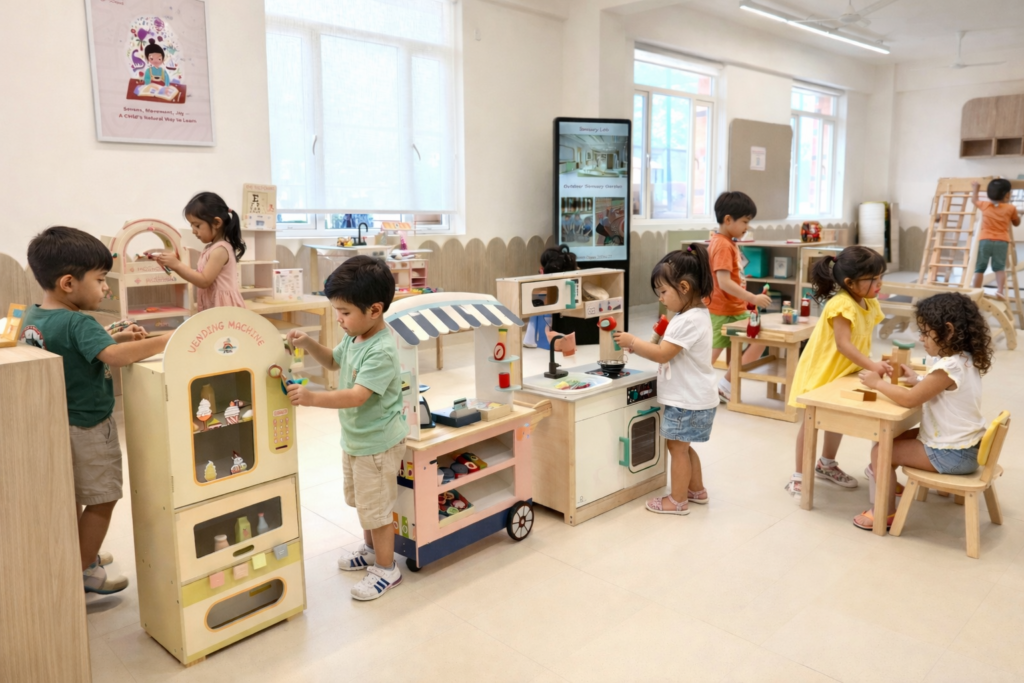
A child spends roughly 15,000 hours inside a school building before finishing primary education. That is not just time — it is the texture of childhood itself. And yet, most school admission conversations in 2026 still revolve around rankings, fee structures, and board affiliations. Very few ask the question that arguably matters most: What does this space feel like to a seven-year-old?
Understanding why learning environments matter more than ever in school admissions 2026 is not a philosophical exercise. It is a deeply practical one. Research in developmental psychology consistently shows that the physical, emotional, and social environment of a school shapes how children think, feel, and grow — sometimes more powerfully than the curriculum itself.
For thoughtful parents navigating school admissions in Gurgaon, this shift in perspective can change everything about the school you choose.
Key Takeaways 📌
- The learning environment — physical, emotional, and social — directly influences a child’s cognitive and emotional development.
- Emotionally safe learning environments reduce anxiety and unlock deeper curiosity-led learning.
- School infrastructure in 2026 goes far beyond buildings — it includes sensory spaces, collaborative zones, and outdoor learning areas.
- Parents should look beyond academics and ask how a school feels for their child.
- Choosing the right environment early can set the foundation for confidence, resilience, and future-ready skills.
What “Learning Environment” Actually Means in 2026
The phrase “learning environment” gets used a lot. But it deserves a closer look.
A learning environment is everything that surrounds a child during the school day — the layout of the classroom, the tone of a teacher’s voice, the availability of open space to move and think, the way conflict is handled on the playground, and whether a child feels genuinely seen.
It is not just infrastructure. It is atmosphere.
In 2026, the best schools understand this deeply. They design spaces that support holistic child development — where a child’s emotional needs are met alongside their intellectual ones. Where learning through discovery is not a special event but an everyday reality.
Think about the difference between a classroom where desks face a whiteboard in rigid rows versus one where children sit in small clusters, surrounded by tactile materials, natural light, and visible examples of their own work. Both are classrooms. But they create very different children.
The Science Behind Spaces 🔬
Neuroscience has been clear for some time: stress impairs learning. When a child feels unsafe — emotionally or physically — the brain’s threat-response system activates. Curiosity shuts down. Memory consolidation weakens.
Conversely, emotionally safe learning environments activate the brain’s exploratory systems. Children ask more questions. They take healthy risks. They remember more, not because they were drilled, but because they were engaged.
This is why learning through multiple senses is not a luxury feature — it is a developmental necessity. Schools that integrate sensory learning spaces in Gurgaon are not following a trend. They are following the evidence.
Why Learning Environments Matter More Than Ever in School Admissions 2026
The admission season of 2026 is different from those that came before it. Parents are more informed. Children are navigating a more complex world. And the gap between schools that prioritise environment and those that do not has never been wider.
Here is what has changed — and why it matters right now.
1. Post-Pandemic Emotional Needs Are Still Real
Children who began school during or after the disruptions of recent years carry emotional imprints that traditional schooling often ignores. Anxiety, difficulty with transitions, and challenges in social interaction are more common than ever among young learners.
Schools with emotionally safe learning environments — ones where teachers are trained to notice and respond to emotional cues, where helping children manage big emotions is considered part of the curriculum — are not just being kind. They are being effective.
2. The World Children Are Growing Into Demands Different Skills
Rote memorisation will not prepare a child for 2035. Critical thinking, collaboration, creative problem-solving, and emotional intelligence will. These skills do not emerge from textbooks alone. They emerge from real-world learning experiences — project-based work, open-ended exploration, and joyful classrooms where making mistakes is part of the process.
When parents ask about what to look beyond academics during school visits, they are asking exactly the right question.
3. Early Years Are the Most Sensitive Period
The brain is most plastic — most open to shaping — in the first eight years of life. The environments a child inhabits during this window do not just influence learning. They wire the neural pathways that will govern how that child approaches challenges, relationships, and self-belief for decades.
This is why nursery admissions in Gurgaon for 2026 deserve the same careful consideration as any other milestone decision. Getting the environment right at the start is far easier than correcting course later.
What to Look for in a Learning Environment 🏫
So what should parents actually observe when visiting a school? Here is a practical guide.
| What to Look For | Why It Matters |
|---|---|
| Natural light and open space | Reduces stress, supports focus and mood |
| Visible student work on walls | Signals that children’s ideas are valued |
| Flexible seating and zones | Supports different learning styles and needs |
| Outdoor learning areas | Connects children to nature and movement |
| Calm, warm teacher interactions | Models emotional regulation and safety |
| Sensory and tactile materials | Supports experiential learning and memory |
| Quiet corners alongside active spaces | Respects different temperaments |
Questions Worth Asking on a School Visit
- How does the school support a child who is having a hard day emotionally?
- What does a typical morning look like for a five-year-old here?
- How much time do children spend in self-directed, curiosity-led learning?
- How does the school communicate with parents about a child’s emotional wellbeing?
These questions reveal far more than any brochure will.
The Connection Between Environment and Confidence
Confidence-building education does not happen through praise alone. It happens when children are placed in environments where they are genuinely challenged — and genuinely supported.
A child who has space to try, fail, reflect, and try again develops a very different relationship with difficulty than one who has been shielded from it. Schools that understand this design their spaces and their teaching accordingly.
Precision schooling approaches that observe each child’s individual learning profile and respond to it — rather than applying a one-size-fits-all method — are a direct expression of this philosophy. When a child feels known and understood by their school, confidence follows naturally.
This is also why the joy of childhood and play-based learning should not be seen as a soft extra. Play is how young children make sense of the world. Schools that protect and design for play are protecting the very mechanism through which early learning happens.
Why Learning Environments Matter More Than Ever: A Parent’s Checklist ✅
Before finalising a school for 2026-27 admissions, consider running through these reflections:
- Does the school feel calm and welcoming when you walk in — not just impressive?
- Are children visibly engaged — curious, talking, building, exploring?
- Does the environment feel designed for children — or for adults to observe children?
- Is emotional wellbeing mentioned as a priority, not an afterthought?
- Do teachers seem to genuinely enjoy being in the space?
If most of these feel true, the environment is likely one where a child will thrive.
For families still in the process of shortlisting, this guide to choosing the right school in Gurgaon for 2026-27 offers a structured way to think through the decision.
Conclusion: The Environment Is the Education
The building does not teach. But it shapes the conditions under which teaching becomes possible.
In 2026, the most important shift a parent can make in the admissions process is to stop asking only what a school teaches and start asking how it feels to learn there. The learning environment — its warmth, its design, its emotional intelligence — is not a backdrop to education. In many ways, it is the education.
Actionable next steps for parents:
- Book a school visit — not a virtual tour, but a real walk-through during school hours.
- Observe the children, not just the facilities. Are they engaged? Do they seem at ease?
- Ask specific questions about emotional support, sensory learning spaces, and how the school handles a child’s difficult days.
- Trust your instincts — if the environment feels right for your child, that feeling is data.
The right environment does not just prepare children for the next grade. It prepares them for life.