Nursery Admissions 2027-28 in Gurgaon: How to Choose a Next-Gen School for Your Child
November 10, 2026 2026-11-10 10:23Nursery Admissions 2027-28 in Gurgaon: How to Choose a Next-Gen School for Your Child

Nursery Admissions 2027-28 in Gurgaon: How to Choose a Next-Gen School for Your Child
Choosing a nursery is an unusual decision. Your child cannot tell you what they need, the school cannot show you results, and everyone you ask has a different opinion. Yet the first formal school experience shapes how a child feels about learning for years afterwards.
As nursery admissions for 2027-28 open across Gurgaon, many parents are asking a sharper question than before: what does a genuinely next-gen school look like for a three-year-old? This guide offers a calm, practical answer.
Key Takeaways
• A next-gen nursery is defined by how children learn, not by the gadgets in the classroom
• India’s National Education Policy 2020 treats ages 3 to 8 as one foundational stage built on play and activity
• Emotional safety comes first. Children who feel secure explore, ask and attempt more
• Look for visible signs in the classroom, not just claims in the brochure
• Navriti admits from Nursery for 2027-28, with a learning programme that combines thematic, activity-based learning with early scientific inquiry
What “Next-Gen” Should Mean for a Three-Year-Old 🌱
The phrase is used freely in school marketing, so it helps to define it. For nursery-age children, next-gen does not mean tablets or early coding. It means a school that applies what we now understand about early brain development: that young children learn through movement, touch, language, relationships and repeated, playful experience.
The National Education Policy 2020 reflects the same understanding. It describes a foundational stage covering ages 3 to 8, with flexible, play-based and activity-based learning. A nursery that follows this approach looks very different from a miniature primary classroom with children seated in rows, tracing letters.
Five Things to Look for in a Nursery Classroom 👀
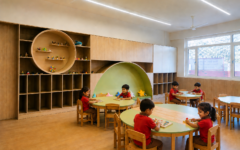
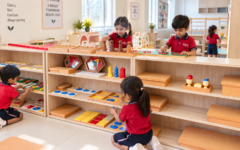
1. Children are doing, not waiting. Watch what children are occupied with. Pouring, sorting, building, drawing, singing and talking are all signs of purposeful learning at this age.
2. Teachers speak with children, not at them. A good early-years teacher kneels, listens fully and asks open questions. Notice the tone of voice, because children read tone long before they understand words.
3. Learning is organised around themes. Thematic learning lets a child meet an idea, such as water, plants or community helpers, through stories, sensory play, movement and conversation. The concept sticks because it is experienced from several angles.
4. Curiosity is treated as the goal. Questions should be welcomed, and “I do not know, let us find out” should sound natural in the room.
5. The environment feels safe and calm. Children thrive where routines are predictable, spaces are inviting and transitions are gentle. Our post on why children’s behaviour is often communication explains why this matters so much in the early years.
Questions Worth Asking the Admissions Team 💬
- How is a typical day structured, and how much of it is free exploration versus guided activity?
- How do you support a child who finds separation difficult in the first weeks?
- How do teachers track a child’s progress without formal tests?
- How and how often do you communicate with parents?
- What is the school’s approach to early writing and reading, and when does it begin?
Be cautious of any nursery that promises early academic acceleration. Research on early childhood development consistently points to language-rich play and secure relationships as the strongest foundation for later literacy and numeracy.
How Navriti Approaches the Early Years 🔬
Navriti School in DLF Phase IV, Gurgaon, was designed with scientists, and its early-years programme reflects that. The Nursery learning programme is built on the National Education Policy 2020 and the National Curriculum Framework for School Education 2023, and uses thematic learning resources that progress in stages. Each theme is activity-oriented and builds early skills of scientific inquiry, exploration and application through experience.
The wider learning programme aims to educate the whole child, with attention to emotional, social, ethical and cognitive growth together. It is a calm, joyful approach, which you can read more about in our reflection on where play meets learning.
Common Myths About Nursery Education 🧩
Myth: Earlier writing means a stronger start. Fine motor skills, language and attention develop at their own pace. Children who spend their nursery years squeezing, pouring, drawing, climbing and talking typically arrive at writing better prepared than those drilled in letter formation too soon. The foundation for writing is built in the hands, the shoulders and the imagination long before a pencil is involved.
Myth: Play is a break from learning. For a three or four-year-old, play is how learning happens. When a child sorts leaves by size, negotiates a turn on the slide or invents a story with blocks, they are practising classification, social reasoning, language and problem solving at once.
Myth: A bigger campus means a better nursery. Space and facilities help, but what matters most is the quality of adult attention and the design of the child’s day. A calm, well-organised room with attentive teachers will do more for a young child than an impressive building without them.
Myth: The child must be “ready” in a fixed way. Children arrive with different temperaments. Some walk in confidently, others cling for a week. A good nursery plans for both, and a child who takes time to settle is not a child who has failed to be ready.
Signs Your Child Is Ready for Nursery 🌟
Readiness is less about skills than about comfort. Many children are ready when they show some of the following, though none is a requirement:
- They show interest in other children and in new activities
- They can communicate basic needs in words or gestures
- They can be away from a parent for short periods with a familiar caregiver
- They are beginning to manage simple routines such as eating or washing hands with help
If your child is not yet showing these signs, speak to the school. A thoughtful admissions team will have seen many children at the same stage and can offer practical, reassuring guidance.
Preparing Your Child and Yourself 🧸
A few gentle steps can make the transition smoother:
- Talk about school in warm, ordinary terms, as a place with friends, stories and play
- Visit the campus together if the school allows it, and let your child explore at their own pace
- Practise small independence skills such as washing hands or carrying a bag
- Keep routines steady in the weeks before the start
- Check your own feelings first. Children read parental anxiety quickly
Age criteria for Nursery vary between schools, so confirm the requirement for 2027-28 directly with the admissions team before you plan further.
Conclusion
The right nursery is not the one with the longest brochure. It is the one where your child walks in, finds something that interests them, and does not want to leave when you arrive for pickup. With nursery admissions open for 2027-28 in Gurgaon, you have time to visit, observe and ask honest questions.
Choose a school that treats curiosity as the point of early education, and you will have chosen well. When you are ready to narrow the list, seven signs of a right choice can help you finalise.