Primary School Admission in Gurgaon 2026: What Makes a School Truly Future-Ready
April 22, 2026 2026-04-22 10:35Primary School Admission in Gurgaon 2026: What Makes a School Truly Future-Ready
Primary School Admission in Gurgaon 2026: What Makes a School Truly Future-Ready
Only 1 in 3 skills that today’s primary school children learn will still be relevant by the time they enter the workforce — according to the World Economic Forum’s Future of Jobs research. That single fact should quietly reshape how every parent in Gurgaon thinks about school selection this year.
Primary School Admission in Gurgaon 2026: What Makes a School Truly Future-Ready is not just a question about rankings or infrastructure. It is a question about what kind of human being a school is helping your child become. As admission season peaks across the city, the real conversation worth having is this: beyond the brochure, what does a school actually do for a child’s growth?
This guide is for parents who are asking exactly that.
Key Takeaways 📌
- Future-ready education goes far beyond academics — it builds curiosity, confidence, and emotional resilience.
- The learning environment inside a school shapes a child’s relationship with learning itself, often more than the curriculum does.
- Holistic child development — social, emotional, and intellectual — is the strongest predictor of long-term success.
- Asking the right questions during school visits reveals far more than any school ranking list.
- In Gurgaon’s competitive admissions landscape, early research and thoughtful shortlisting make all the difference.
What “Future-Ready” Actually Means for a 6-Year-Old
The phrase “future-ready” gets used a lot. But what does it genuinely look like for a child in Grade 1 or Grade 2?
It is not about coding classes or robotics labs (though those can help). It is about whether a child leaves school each day feeling capable, curious, and safe enough to try again tomorrow.
A truly future-ready school builds these qualities from the earliest years:
| Quality | What It Looks Like in a Classroom |
|---|---|
| Curiosity | Children ask questions freely; teachers celebrate “I don’t know yet” |
| Confidence | Children present ideas, make mistakes, and try again without fear |
| Collaboration | Group projects, peer learning, shared problem-solving |
| Emotional intelligence | Feelings are named, respected, and guided — not suppressed |
| Adaptability | Learning happens through discovery, not just instruction |
These are the future-ready skills that no exam can fully measure — but every parent can observe during a school visit.
For a deeper look at what separates great schools from good ones, this guide on what parents should look beyond academics during Gurgaon school admissions is worth reading carefully.
The Learning Environment: It Shapes More Than You Think
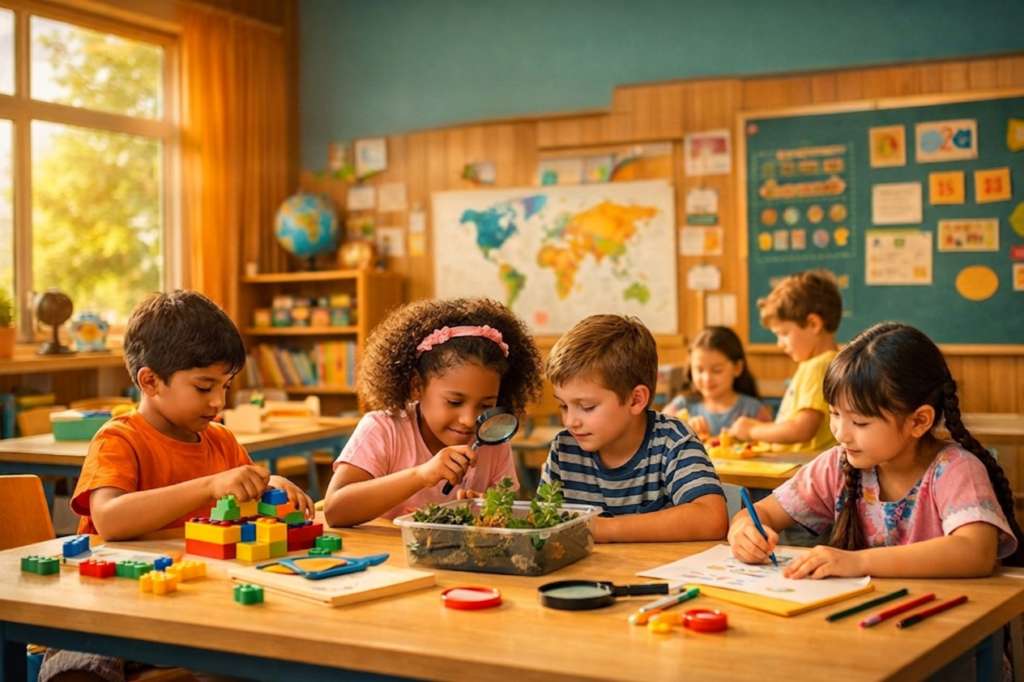
Walk into two different primary schools in Gurgaon. In one, children sit in neat rows copying from a board. In the other, they are huddled around a table, debating why a plant grew faster near the window.
Both schools may have the same CBSE affiliation. Both may charge similar fees. But the learning environment — the physical space, the emotional climate, and the teaching approach — creates entirely different outcomes.
Research in developmental psychology consistently shows that children learn best when they feel emotionally safe. When a child is anxious, their brain’s stress response actually reduces the capacity for memory and reasoning. This is not abstract science — it is the reason why emotionally safe learning environments are not a luxury. They are the foundation.
What should parents look for?
🔍 Signs of a Genuinely Nurturing Environment
- Teachers who listen — not just explain
- Classrooms with space to move, explore, and create
- Mistakes treated as learning moments, not failures
- A visible sense of joy — children who look engaged, not just compliant
- Inclusion of all learners, regardless of pace or style
The way a school handles a child’s first difficult day says everything about its values. This is why why learning environments matter in school admissions 2026 in Gurgaon deserves a place in every parent’s research process.
Curiosity-Led Learning vs. Rote Learning: The Real Difference
Here is a gentle but important truth: children are born scientists. Every toddler who drops a spoon off a high chair — again and again — is running an experiment. Schools that preserve this instinct produce children who love learning. Schools that replace it with memorisation produce children who learn only when required to.
Curiosity-led learning is not a teaching trend. It is grounded in decades of cognitive science. When children discover something for themselves — through exploration, play, or guided inquiry — they retain it longer, understand it more deeply, and feel more motivated to keep going.
This is what science-informed teaching looks like in practice:
- A maths lesson built around a real market scenario, not just a textbook problem
- A language class where children write stories about things they genuinely care about
- A science activity where the question comes from the child, not the teacher
- Learning through discovery rather than passive listening
The shift from “teaching children what to think” to “teaching children how to think” is the single most important transformation a school can make. And it is entirely visible — if parents know what to look for during admission interactions.
This guide on what parents should ask during admissions interactions in Gurgaon schools offers a practical set of questions that reveal a school’s true teaching philosophy.
Holistic Child Development: The Full Picture
Many parents arrive at primary school admission season focused on one question: “Is this school academically strong?” That is a fair question. But it is incomplete.
Holistic child development means nurturing the whole child — not just the part that takes tests.
Consider what a child actually needs to thrive, not just in school, but in life:
✅ Intellectual growth — strong foundations in literacy, numeracy, and reasoning
✅ Emotional development — the ability to understand and manage their own feelings
✅ Social skills — learning to collaborate, communicate, and resolve conflict
✅ Physical wellbeing — movement, play, and rest built into the school day
✅ Creative expression — art, music, drama as genuine learning, not afterthoughts
A school that scores high on academics but low on emotional safety is not preparing children for a full life. It is preparing them for a narrow one.
The good news? These qualities are not in conflict. Schools that invest in confidence-building education and joyful classrooms consistently see stronger academic outcomes too — because children who feel good about themselves learn more effectively.
For parents navigating this balance, helping your preschooler manage big emotions is a thoughtful resource that connects emotional development to school readiness.
How to Shortlist the Right Primary School in Gurgaon 2026
With dozens of CBSE primary schools in Gurgaon, shortlisting can feel overwhelming. Here is a practical framework that helps parents cut through the noise.
Step 1: Define What Matters Most to Your Family
Before researching schools, write down your top three priorities. Is it proximity? Teaching philosophy? Class size? The answer shapes everything that follows.
Step 2: Visit Schools in Person — and Observe
No brochure tells the full story. During a visit, watch how teachers interact with children. Notice whether the hallways feel calm or chaotic. Ask what a typical school day looks like — hour by hour.
Step 3: Ask Questions That Reveal Values
- “How does the school handle a child who is struggling emotionally?”
- “What does a typical project or activity look like in Grade 1?”
- “How do teachers communicate with parents about learning progress?”
Step 4: Trust What You Feel
Parents often know more than they think they do. If a school feels warm, purposeful, and genuinely child-centred — that feeling is data.
For a structured approach to this process, the complete guide to shortlisting the right school in Gurgaon for admissions 2026-27 walks through each step in detail.
Also worth reviewing: the Gurgaon school admission checklist for a practical document-by-document guide to the process.
A Note on Timing: Why Early Action Matters
Seats at thoughtful, progressive primary schools in Gurgaon fill up faster than most parents expect. The schools that invest most in small class sizes, trained teachers, and rich learning environments are precisely the ones with the least availability.
If a family is considering a mid-year move or switching schools, switching schools in 2026: is mid-primary admission the right move addresses the key considerations with honesty and care.
And for families still in the early stages of research, primary school admissions 2026 in Gurgaon: helping your child transition with Grade 1 readiness and confidence is an excellent starting point.
Conclusion: Choose the School That Sees the Whole Child
Primary School Admission in Gurgaon 2026: What Makes a School Truly Future-Ready comes down to one central idea: the best school for a child is not the most famous one, or the most expensive one. It is the one that sees who that child is — and who they are becoming.
Look for schools where real-world learning experiences are woven into every day. Where teachers are trained not just in subjects, but in child development. Where education beyond exams is not a slogan but a daily practice.
✅ Actionable Next Steps for Parents
- Visit at least two or three schools before making a decision — in person, not just virtually.
- Bring your child to at least one visit and observe how they respond to the environment.
- Ask about teaching philosophy directly — listen for specificity, not buzzwords.
- Check seat availability early — the best schools close their lists quickly.
- Trust the school that makes your child feel curious and safe — not just the one with the longest list of achievements.
The right school will not just prepare a child for the next grade. It will prepare them for a life of learning, confidence, and genuine joy.