Nursery Admissions 2027–28 in Gurgaon: When to Start, What to Look For, and How to Decide
July 6, 2026 2026-08-20 8:08Nursery Admissions 2027–28 in Gurgaon: When to Start, What to Look For, and How to Decide
Nursery Admissions 2027–28 in Gurgaon: When to Start, What to Look For, and How to Decide
Choosing a nursery school is the first major school decision most parents make. It arrives before most parents feel ready for it, and it arrives with no instruction manual. The child is two and a half or three years old. The parent has strong instincts, incomplete information, and a market full of schools all saying roughly the same things about themselves.
This guide is for parents whose child will be joining nursery in the 2027–28 academic year. If you’re reading this in July 2026, you’re in a good position: you have time to do this well.
Key Takeaways
• Nursery is not a warm-up for “real” school — the early years are where the most foundational learning happens, and the environment matters enormously
• The best nursery schools in Gurgaon are not necessarily the most expensive or most famous — they’re the ones that understand young children
• Age eligibility matters — check cut-off dates for 2027–28 now; children born around the April cut-off need particular attention
• What to observe during a school visit is different for nursery than for primary — the physical environment and how teachers interact with children tells you most of what you need to know
• Applications for 2027–28 will typically open October–December 2026 — starting research now gives you time to visit calmly before the pressure builds
Why Nursery School Actually Matters 🧠
There’s a tendency to treat nursery school as a transitional arrangement — somewhere children go to get used to being away from home, learn to share, and be looked after safely while parents work. All of those things are true, but they describe a fraction of what good nursery school does.
The years between ages 3 and 6 represent the most intensive period of brain development in a human life. The neural connections being built during this period — for language, attention, emotional regulation, spatial reasoning, and social cognition — are built primarily through physical experience, play, and interaction with people and environments. A nursery school that understands this designs everything differently from one that doesn’t: the physical spaces, the daily rhythm, the role of adults, the balance between structure and freedom.
This is what good early years education looks like. It doesn’t look like worksheets and phonics drills. It looks like purposeful exploration with skilled adults who know when to guide and when to step back.
When parents ask “does it matter which nursery school I choose?”, the honest answer is: yes, it does. Not because the wrong choice is catastrophic, but because the right choice — a school genuinely designed around how young children develop — gives a child a fundamentally different start.
The Age Criteria Question ✅
Most Gurgaon schools use March 31st as the cut-off date for nursery admission. For 2027–28, a child would typically need to be three years old by March 31st, 2027 — meaning a birth date on or before March 31st, 2024.
Check this for each school on your shortlist. Some schools have slight variations. And if your child’s birthday is in the February–April window, the eligibility question becomes relevant in a different way: a child who is technically eligible but turns three in March will be among the youngest in their cohort for the full year. Whether that matters depends on the child and the school’s approach to mixed-readiness classrooms.
Navriti’s Neev programme admits pre-primary children from nursery age. The 2027–28 eligibility criteria are available on the admissions page.
What to Actually Look For When Visiting a Nursery School 👁️
Most nursery school marketing sounds identical. “Child-centric.” “Holistic.” “Safe and nurturing.” These phrases are so universal as to be meaningless. What isn’t universal is what you actually observe when you visit.
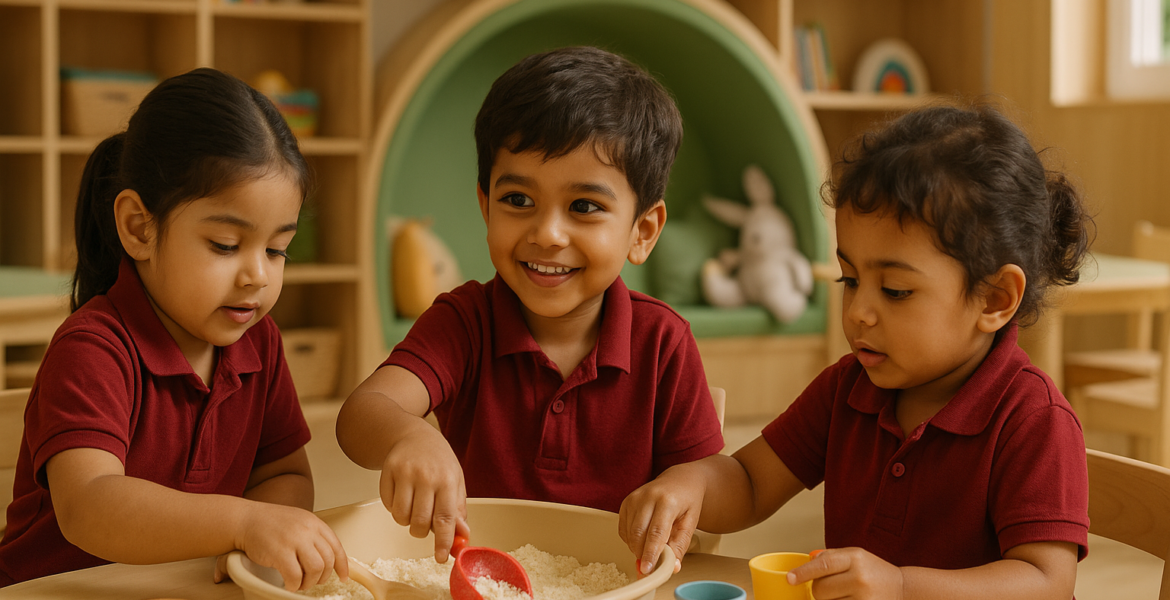
Watch what children are doing. Are they engaged and self-directed — absorbed in something they chose — or are they moving between activities with the slightly glazed expression of children who are being managed rather than taught? Engaged children in a good nursery environment are usually noisy, focused, and visibly absorbed. They’re not sitting quietly in rows.
Watch how teachers respond to children. When a child is frustrated, does the teacher acknowledge the feeling before redirecting? When a child does something unexpected, does the teacher treat it as interesting or inconvenient? The quality of adult-child interaction in the early years is the single most important variable in the quality of the school.
Look at the physical environment. Is the space designed for children — at their height, with accessible materials they can choose independently — or is it an adult space that children inhabit? Are there different kinds of spaces: some for active, messy, physical play; some for quieter, focused activity? The physical environment isn’t decoration. It’s curriculum.
Ask about the daily rhythm. How much of the day is child-led versus adult-directed? How is outdoor time structured? What happens when a child doesn’t want to participate in a group activity? These questions reveal the school’s actual philosophy, not the prospectus version of it.
Questions Worth Asking at a School Visit 📝
- “What does a typical morning look like for a nursery child here?”
- “How do you handle a child who is finding separation difficult in the first few weeks?”
- “What is your approach to learning to read and write at nursery age — when do you start, and how?”
- “How do you communicate with parents about how their child is doing — not just at report time?”
- “What training do your nursery teachers have in early childhood development specifically?”
The answers will tell you more than the campus tour. Specific answers are encouraging. Vague answers that stay at the level of principle, without connecting to what a Tuesday morning actually looks like, are worth probing further.
How to Build Your Shortlist 📋
In July, a reasonable approach is to identify three to five schools within a manageable distance and spend August and September visiting them — ideally on a regular school day rather than at a formal open day, which shows you the school in its best-prepared rather than most typical state.
Talk to parents of current nursery children at each school, not parents of older children whose nursery experience was several years ago. Schools change, and recent experience is more useful.
Check the commute realistically, including traffic at 8am. A school that is theoretically fifteen minutes away but practically forty-five on a Tuesday morning has a real cost that compounds across four years.
When to Apply
Most Gurgaon schools open nursery applications between October and December 2026 for the 2027–28 academic year. Having visited your shortlisted schools before October means you arrive at the application window with a clear preference and the confidence that comes from having made an informed decision.
For Navriti School’s Neev programme, you can register your interest for 2027–28 now, ahead of the formal application window.
Conclusion
Nursery admissions research done well is calm, specific, and based on what you actually see. It doesn’t require a spreadsheet or a ranking table. It requires visiting schools with open eyes, asking questions that the brochure can’t answer, and trusting what you observe over what you’re told.
Starting in July 2026 means you have that time. Use it well, and the decision you make in October will be one you’re confident about — not just hopeful about.