Primary School Admissions 2027–28 in Gurgaon: How to Identify the Right School Well Before Deadlines
July 10, 2026 2026-08-20 8:08Primary School Admissions 2027–28 in Gurgaon: How to Identify the Right School Well Before Deadlines
Primary School Admissions 2027–28 in Gurgaon: How to Identify the Right School Well Before Deadlines
Primary school admissions feel different from nursery admissions. The child is older, the stakes feel more concrete, and the decision involves a school that will shape five or six years of your child’s education — through Grade 1 to Grade 5, the years when reading, writing, mathematical thinking, and intellectual habits are being built for the first time.
Parents who approach primary admissions well tend to share one characteristic: they started early enough that they weren’t rushed. This guide is for those families — the ones planning for 2027–28 with enough time to get it right.
Key Takeaways
• Primary school shapes more than academic outcomes — it shapes how a child relates to learning, difficulty, and their own abilities for years afterwards
• The right primary school isn’t the most prestigious one — it’s the one that matches this particular child’s needs, learning pace, and temperament
• Most Gurgaon schools open Grade 1–5 applications between October and December — visiting before October gives you unhurried time to evaluate properly
• The questions to ask at a primary school are different from nursery — they go beyond environment to curriculum sequencing, assessment, and how the school handles the range of learners
• Starting in July means you can visit during a live school day, talk to current parents, and make a considered decision before the deadline pressure arrives
What Primary School Actually Does to a Child 📚
The primary years — roughly ages 6 to 11, Grades 1 through 5 — are when children move from learning to read to reading to learn. The shift is enormous. A child who enters Grade 1 still decoding individual words leaves Grade 5 capable of reading a chapter book, constructing an argument, solving multi-step mathematical problems, and communicating in writing with some fluency.
But the primary years do something else too, which is less visible in league tables and report cards. They establish how a child thinks about themselves as a learner. A child who experiences primary school as a place where their curiosity is valued and their effort matters more than their mistakes tends to approach difficult work differently from a child who experiences it as a place where the point is to produce correct answers. These orientations form slowly and durably, and they are much harder to change in secondary school than they are to build correctly in primary.
This is what the primary school decision is actually about. Not just which school will produce the best Grade 5 results, but which school will produce a ten-year-old who approaches intellectual difficulty with confidence rather than avoidance.
Evaluating Primary Schools: What to Look For 🔍
The things that matter in a primary school are harder to see than the things that look good on a brochure. Here’s what to pay attention to when visiting.
How teachers respond to wrong answers. This is the single most revealing moment in any classroom observation. Does the teacher acknowledge what was interesting about the wrong answer — “that’s a reasonable thing to think, tell me why” — or does it get marked and moved past? The first response builds a different kind of learner than the second.
Whether children can explain their reasoning, not just their answers. In a well-taught primary classroom, if you ask a child why the answer is what it is, they can usually explain it. In a classroom focused on performance rather than understanding, children often produce correct answers with no underlying comprehension. The difference becomes visible in later years but is built in the primary ones.
How the school handles the range of learners in one class. In any primary classroom, there will be children working at different speeds and different levels. Ask the school directly: how do you manage that? The answer reveals how thoughtfully the school thinks about individual children rather than cohorts.
The relationship between assessment and teaching. Assessment in the best primary schools is used to inform teaching — what does this child need next? Assessment in less effective schools is used to rank and report. Ask how the school assesses in the early primary years and what happens with that information.
Navriti’s Navya Programme: Grades 3–5 🌟
For parents considering primary admissions specifically at the Grade 3–5 level, Navriti’s Navya programme is worth understanding in detail. Navya is built around the premise that children in the upper primary years are ready for — and benefit from — structured intellectual challenge, but that challenge should develop genuine understanding rather than examination performance.
The programme emphasises critical thinking across subjects: children are asked not just to produce answers but to examine assumptions, construct arguments, and work with problems that don’t have single correct solutions. This reflects both the NEP 2020 framework and the school’s advisory board’s influence on how learning is sequenced.
For families considering Navriti for Grade 1 or 2 entry into the Neev to Navya pathway, the continuity of approach across the early and primary years is worth understanding — the same values that shape the pre-primary environment continue through primary, which means children don’t experience a jarring shift in expectations as they move up.
The Questions to Ask on a Primary School Visit 📝
- “How do you approach concept teaching in mathematics — do you work from concrete to abstract, or do you introduce formal notation early?”
- “What does assessment look like in Grade 2 and Grade 3 — are children formally examined, and how is the output used?”
- “How do teachers manage a class where some children are significantly ahead and some are significantly behind?”
- “What is your homework policy for primary years, and what’s the reasoning behind it?”
- “How does a parent find out if their child is struggling — before the end-of-term report?”
Schools that answer these questions specifically, with reference to actual classroom practice, are taking their curriculum seriously. Schools that respond with general statements about philosophy are worth pressing for specifics.
Building the Shortlist in July 📋
A sensible July–September approach for primary admissions:
Identify two to four schools within a realistic commute distance. Check their admissions pages for 2027–28 information — some schools publish timelines early, which tells you when you need to have visited and decided. Book school visits for August or September, requesting to visit during a live school day rather than a formal open day if at all possible.
Talk to parents of children who are currently in primary at each school. Ask specifically: what did you think the school was like at admission, and what do you think it’s like now that your child has been there for a year or two? The gap between those two answers is often the most useful information you’ll get.
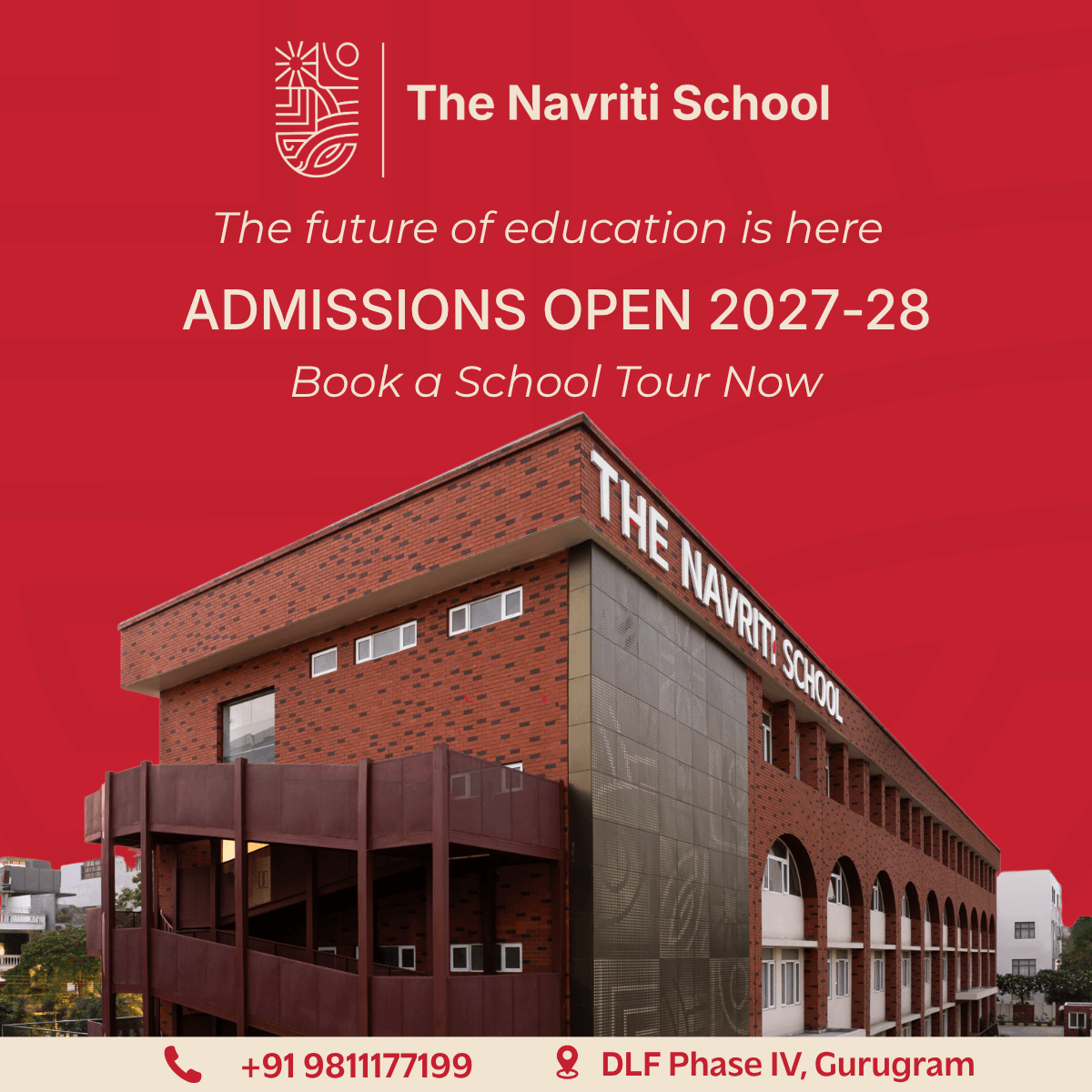
For Navriti School’s primary programme, register your interest for 2027–28 to be notified when applications open and to arrange a visit ahead of the formal admissions window.
Conclusion
Primary school admissions 2027–28 in Gurgaon will open formally in the October–December window. Parents who have done their research by then — who have visited, asked specific questions, and have a clear sense of what they’re looking for — make considerably better decisions than those arriving at the same window with no prior preparation.
July is not too early. It is, for the families who use it well, exactly the right time.