Future-Ready Schools in Gurgaon: What the Term Means and Which Schools Actually Deliver It
July 27, 2026 2026-08-20 8:08Future-Ready Schools in Gurgaon: What the Term Means and Which Schools Actually Deliver It

Future-Ready Schools in Gurgaon: What the Term Means and Which Schools Actually Deliver It
“Future-ready” has become one of the most overused phrases in Indian school marketing. It appears in prospectuses, on banners outside school gates, and in every third admissions brochure in Gurgaon. Used this way, the phrase means almost nothing — it signals aspiration without specifying anything about what a school actually does.
But the underlying idea is real and worth taking seriously. Some schools genuinely are preparing children for a world that will look different from today’s. Others are preparing children for examinations. The two goals are not always the same thing, and parents choosing schools for 2027–28 deserve a clearer way to tell them apart.
Key Takeaways
• “Future-ready” describes a genuine educational orientation, not a marketing category — but distinguishing genuine from performative requires knowing what to look for
• Future-readiness is not primarily about technology — smartboards and coding electives don’t produce future-ready learners; teaching methods do
• Three things that genuinely predict future-readiness: how the school teaches thinking (not content), how it handles failure, and whether it develops independence rather than compliance
• Most children entering nursery in 2027 will work in roles that don’t yet exist — the skills they’ll need are adaptability, critical thinking, and the ability to learn continuously
• Visiting with this specific lens changes what you notice in a school and what questions you ask
What “Future-Ready” Actually Means 🔭
The World Economic Forum and numerous education researchers have documented a consistent shift in what employers across sectors are looking for over the next decade: critical thinking, creative problem-solving, collaboration, communication, and the ability to learn continuously as conditions change. These aren’t new ideas — they’ve been appearing in education research for thirty years — but the urgency has increased as the pace of change in the economy and technology has accelerated.
What this means practically for a school is not primarily about adding technology to classrooms. A child who can navigate a tablet at age six but cannot think independently, tolerate uncertainty, or reason through an unfamiliar problem is not future-ready. A child who has spent their primary years learning to think carefully, ask good questions, and persist through difficulty — regardless of whether their school had a makerspace — is considerably better equipped.
The technology is the easy part. The teaching methods are the hard part. Future-ready schools invest primarily in the second.
Three Genuine Markers of a Future-Ready School 📊
How the school teaches thinking, not just content. In a content-focused school, the lesson has a piece of knowledge to transmit and the teacher’s goal is to get children to receive and remember it. In a thinking-focused school, the lesson has a problem or question at its centre, and the teacher’s goal is to get children to reason towards understanding. The second type produces learners who can do something with knowledge rather than learners who can reproduce it under examination conditions.
Ask a school directly: in a typical science or mathematics lesson, what is the teacher doing, and what are the children doing? The ratio of teacher-doing to child-doing is revealing.
How the school handles failure and difficulty. Future-ready learners are people who have learned that difficulty is a signal to think harder, not to stop. This disposition is built — or broken — in the early and primary years, by how classrooms respond to mistakes. Schools where wrong answers are visibly marked, moved past quickly, or treated as evidence of insufficient effort teach children that the goal is to avoid being wrong. Schools where wrong answers are treated as useful information — “interesting, why did you think that?” — teach children something entirely different.
This is not visible in a prospectus. It is visible in a classroom.
Whether the school develops independence or compliance. A child who does what they’re told in school is an easy school day for everyone involved. A child who asks why, who questions assumptions, who wants to understand the reasoning before accepting the conclusion is a harder school day — and is developing exactly the disposition that future-ready adults need. The best schools understand this and treat intellectual independence as a goal rather than an inconvenience.
What Doesn’t Predict Future-Readiness 🚫
Some things that appear in “future-ready” school marketing but have limited predictive value:
Smartboards and tablets. Technology facilitates learning; it doesn’t create it. A teacher delivering a poor lesson on a smartboard is delivering a poor lesson. The quality of the human interaction is what matters.
Coding electives. Teaching primary children to code is not without value, but it is a narrow skill that addresses one specific future use case. The thinking skills that underlie good coding — logical sequencing, debugging, breaking problems into components — are built in many other contexts too, and more effectively when the child is developmentally ready.
International curriculum elements. Schools that describe themselves as following “global” curricula or having “international” approaches are often describing content additions rather than fundamental changes to how learning works. The geography of a curriculum does not determine its quality.
What to Look For When Visiting a School With This Lens
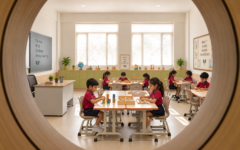
When you visit a school that claims to be future-ready, watch one classroom for ten to fifteen minutes. Specifically: what proportion of the time are children talking and doing, versus watching and listening? What happens when a child says something unexpected or wrong? Does the physical environment suggest that children make choices about how they use materials, or that adults direct every activity?
Then ask the school: can you give me an example of a lesson that didn’t go as planned, and what happened? Schools that are genuinely future-ready have thought about this. Schools that are performing future-readiness tend to give you an answer about their values rather than their practice.
Conclusion
Future-ready is a real thing, and it’s worth finding. The schools that genuinely deliver it aren’t necessarily the ones using the term most prominently. They’re the ones that can show you, in a classroom on a Tuesday afternoon, children doing real thinking — not performing it.
For 2027–28 admissions in Gurgaon, this is the question worth taking into your school visits: not “does this school call itself future-ready?” but “can I see, in how this school actually operates, that children are becoming independent thinkers?”