The Parent’s Guide to How Young Children Actually Learn: What Research Says (and What Schools Often Miss)
September 19, 2026 2026-09-21 12:24The Parent’s Guide to How Young Children Actually Learn: What Research Says (and What Schools Often Miss)
The Parent’s Guide to How Young Children Actually Learn: What Research Says (and What Schools Often Miss)
A three-year-old picks up a fallen leaf, turns it over with intense focus, and asks why the veins look like a tiny road map. In this quiet moment, more learning is happening than in an hour of tracing letters on a worksheet. While traditional systems often prioritize quiet desks and repetitive drills, modern neuroscience tells a much more vibrant story. The way children truly absorb the world is through a complex, beautiful dance of trial, error, and emotional connection.
Understanding the mechanics of a child’s mind is the first step toward choosing an environment that nurtures rather than stifles. This is The Parent’s Guide to How Young Children Actually Learn: What Research Says (and What Schools Often Miss),a roadmap for parents who want to align their child’s education with the actual science of development.
Key Takeaways
- Active Discovery Over Passive Reception: Children learn best when they are “scientists” testing hypotheses, not “vessels” being filled with facts.
- The Emotional Foundation: Learning is physically impossible in a high-stress or overly rigid environment; emotional safety is a prerequisite for cognitive growth.
- Play is the “Work” of Childhood: Purposeful play builds the executive functions, like focus and problem-solving, that are essential for future-ready success.
- The Power of Connection: Young brains develop through “serve and return” interactions with responsive adults.
The Science of the “Absorbent Mind” in 2026
When we talk about how children learn early years Gurgaon parents often ask if their child is “getting ahead.” However, the research suggests we should be asking if their child is “digging deep.” In the first few years of life, the brain forms more than a million new neural connections every second. This isn’t triggered by flashcards; it’s triggered by experience.
Research from developmental psychology highlights that children are born with an innate “statistical compass.” They are constantly gathering data from their environment to figure out how language works, how gravity behaves, and how people react. When a child drops a spoon for the tenth time, they aren’t trying to annoy you; they are conducting a physics experiment.
What Schools Often Miss: The “Execution” Gap
Many traditional schools operate on an industrial model. They assume that if a teacher speaks, the child learns. But there is a significant gap between instruction and acquisition.
| Traditional Schooling Focus | What Research Actually Prioritizes |
|---|---|
| Rote memorization of facts | Developing “learning to learn” skills |
| Staying still and listening | Movement-based, sensory learning |
| Standardized pacing for all | Individualized curiosity-led learning |
| Extrinsic rewards (stickers/grades) | Intrinsic motivation and joy |
Schools that miss the mark often treat the brain like a hard drive. In reality, the brain is more like a muscle that grows through use, particularly through experiential learning. You can read a complete guide for 2027-28 applicants to see how modern institutions are finally bridging this gap.
The Parent’s Guide to How Young Children Actually Learn: What Research Says (and What Schools Often Miss) about Play
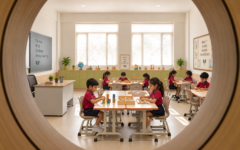
If you walk into a classroom and see children building a bridge with wooden blocks, you might think they are “just playing.” To a scientist-educator, you are witnessing an advanced lesson in structural engineering, collaboration, and spatial reasoning.
Learning through discovery is the gold standard for early childhood. When children play, they are practicing “Executive Function”, the mental processes that enable us to plan, focus attention, and juggle multiple tasks. These are the ultimate future-ready skills.
“Play is often talked about as if it were a relief from serious learning. But for children, play is serious learning. Play is really the work of childhood.”, Fred Rogers
Why Curiosity-Led Learning Wins
When a child follows their own curiosity, their brain releases dopamine. This isn’t just a “feel-good” chemical; it acts as a marker that tells the brain, “This information is important, save it!” This is why a child can remember every detail about a dinosaur they love but struggle to remember a list of random sight words.
Parents exploring primary school admission in Gurgaon 2026 should look for classrooms where the curriculum is flexible enough to follow these “sparks” of interest.
The Emotional Engine: Why Feeling Safe Matters
The brain has a very strict “security guard” called the amygdala. If a child feels anxious, pressured, or disconnected, the amygdala shuts down the path to the prefrontal cortex, the part of the brain responsible for higher-order thinking.
This means a child who is afraid of making a mistake literally cannot learn. Emotionally safe learning environments are not just “nice to have”; they are a biological necessity for intellectual growth. Science-informed teaching prioritizes the relationship between the teacher and the student above the lesson plan. It’s about nurturing young minds so they feel brave enough to take risks.
The Role of “Serve and Return”
Think of learning like a game of tennis. A child “serves” by pointing at a bird or making a sound. The adult “returns” by acknowledging the bird and adding more information (“Yes, that’s a blue jay! Look at his crest.”). This back-and-forth interaction is what builds the brain’s architecture.
In many crowded schools, the “return” is missing. There are too many children and not enough meaningful interactions. When researching the best CBSE school in Gurgaon for nursery and primary, look beyond the infrastructure. Ask about the quality of the “returns” the teachers provide.
Moving Beyond Exams: Education for the Real World
In 2026, the world doesn’t need people who can simply repeat what they’ve been told. It needs thinkers who can adapt. This is why education beyond exams is gaining so much traction among thoughtful parents.
The Parent’s Guide to How Young Children Actually Learn: What Research Says (and What Schools Often Miss) emphasizes that holistic child development includes:
- Social Intelligence: Learning how to navigate conflict and work in teams.
- Resilience: Seeing a “failed” experiment as a data point, not a defeat.
- Creative Thinking: Finding multiple solutions to a single problem.
These are real-world learning experiences that cannot be captured on a multiple-choice test. Schools that focus on confidence-building education help children see themselves as capable learners, which is a far more valuable asset than a high test score in Grade 1.
How to Spot a Future-Ready School
When visiting a campus, don’t just look at the smartboards. Look at the children’s hands. Are they messy? Are they building things? Are they talking to each other? A guide for thoughtful parents making a school campus visit in Gurgaon suggests looking for signs of active engagement rather than passive obedience.
Practical Steps for Parents at Home
Understanding how children learn early years Gurgaon isn’t just about school, it’s about how you interact at home. You can support this research-backed learning by:
- Valuing the Process: Instead of saying “That’s a pretty painting,” try saying “I see you used a lot of blue and made very long strokes with your brush.” This focuses on their effort and choices.
- Allowing “Healthy” Struggle: When your child is trying to tie their shoes or solve a puzzle, wait an extra minute before jumping in. That struggle is where the neural pathways are being built.
- Connecting with Nature: The outdoors is the ultimate joyful classroom. It provides infinite sensory input that screen-based learning simply cannot replicate. For those looking for screen-free ideas, consider activities that actually build skills.
Conclusion
The journey of learning is not a race to a finish line; it is a gradual unfolding of potential. As parents, the most powerful thing we can do is provide an environment that respects the biological reality of how a child’s brain works.
When we choose schools that value curiosity over compliance and discovery over drills, we aren’t just helping them do better in school. We are helping them build a foundation for a life of confidence and continuous growth. The research is clear: when we follow the child’s natural lead, the learning takes care of itself.
Are you ready to look beyond the worksheets and see the incredible scientist living in your living room?