Primary School Admissions in Gurgaon 2027-28: What a Next-Gen Primary Programme Offers
November 14, 2026 2026-11-16 8:14Primary School Admissions in Gurgaon 2027-28: What a Next-Gen Primary Programme Offers
Primary School Admissions in Gurgaon 2027-28: What a Next-Gen Primary Programme Offers
The primary years are where a child decides what kind of learner they are. By Grade 5, most children have formed a firm view: school is interesting, or school is something to get through. A great deal of that view is shaped by how learning is organised in Grades 1 to 5.
As primary school admissions for 2027-28 open in Gurgaon, parents are looking beyond results and infrastructure to the programme itself. This guide explains what a next-gen primary programme should include, and what to ask before you apply.
Key Takeaways
• The primary years have two distinct phases under the National Education Policy 2020: Grades 1 and 2 (foundational) and Grades 3 to 5 (preparatory)
• A next-gen programme builds understanding first, and speed and recall follow
• Experiential learning across science, mathematics, language, arts and social studies is central to the preparatory stage
• Technology should serve thinking, not replace it
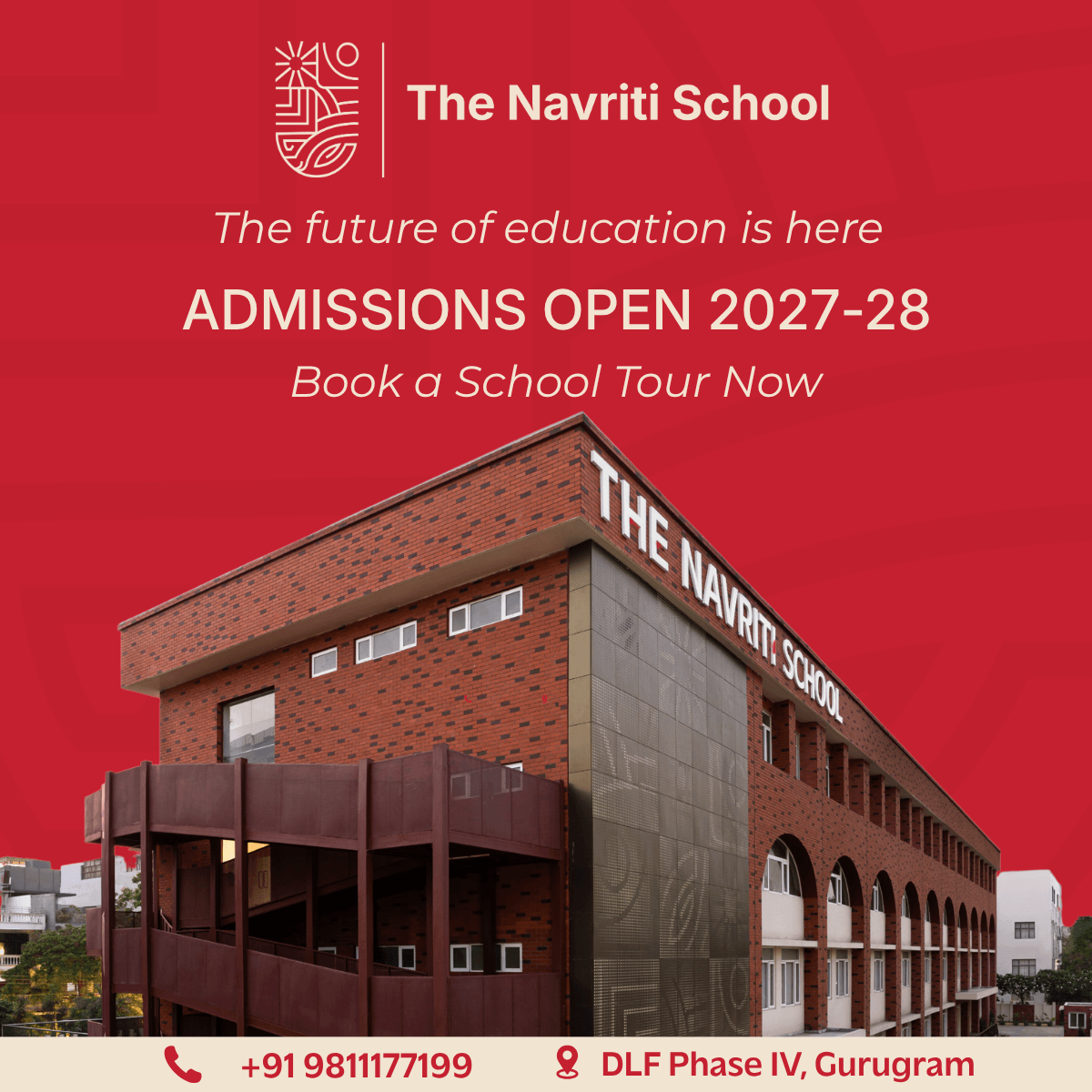
• Navriti admits for Grades 1 to 5 in 2027-28, as part of a Nursery to Grade 7 school
Two Phases, Two Different Needs 📚
The National Education Policy 2020 divides schooling into stages that reflect how children develop. Within the primary years there are two, and a good programme treats them differently.
Grades 1 and 2 remain part of the foundational stage, which covers ages 3 to 8. Learning here is still activity-based, with a growing emphasis on reading, writing and number sense. Children need hands-on experience before abstraction.
Grades 3 to 5 form the preparatory stage, covering ages 8 to 11. The policy calls for experiential learning to expand across the sciences, mathematics, arts, social sciences and humanities. Children begin to handle more structure, more subjects and more independent work.
A school that blurs these stages, for example by pushing heavy textbook work into Grade 1, is out of step with what the policy and developmental research recommend.
What a Next-Gen Primary Programme Looks Like 🔍
Concepts before procedures. In mathematics, children should handle objects, draw models and explain their thinking before memorising a method. In science, they should observe and test before reading the definition.
Strong language foundations. Reading for pleasure, speaking confidently and writing with purpose are the base on which every other subject rests. Ask how the school teaches reading, and how it supports children at different starting points.
Integrated, real-world learning. Subjects connect around themes and questions. A unit on water, for instance, can draw on science, mathematics, geography, art and ethics.
Assessment that informs. Look for ongoing observation, portfolios and feedback that tells a parent what the child understands and what comes next, beyond a single number on a report card.
Purposeful technology. Digital tools should help children create, investigate and collaborate. Our piece on AI-powered learning explores how to judge whether technology is serving learning or merely decorating it.
Emotional and social learning. Collaboration, empathy, resilience and honest conversation about mistakes are skills, and they are taught.
Questions to Take on Your School Visit 💬
- Can you show me a unit of work from Grade 3 and explain how a child moves through it?
- How do you teach reading in Grade 1, and what happens if a child is slower to start?
- How are children assessed, and how is that shared with parents?
- What is the role of homework in the primary years?
- How do you prepare children for the middle years, including Grades 6 and 7?
The best answers are specific. A school that has genuinely designed its programme can describe a Wednesday morning in detail. A school that has only written a philosophy tends to stay general.
How Navriti Approaches the Primary Years 🔬
Navriti School in DLF Phase IV, Gurgaon, follows the CBSE curriculum, with a learning programme built on the National Education Policy 2020 and the National Curriculum Framework for School Education 2023. The programme is competency-driven, concerned with knowledge, skills, values and dispositions together, and designed with scientists to reflect what is known about how children learn.
In Grades 3 to 5, this takes the form of the Navya programme, which brings experiential, inquiry-led learning into every subject. Children in Grades 1 and 2 continue with activity-based learning suited to the foundational stage. Because Navriti runs from Nursery to Grade 7, a child’s journey is planned as one continuous path, so that each stage prepares the next.
Will My Child Fall Behind in an Experiential Programme? 🤔
This is the most common worry parents raise, and it deserves a direct answer. A well-designed experiential programme does not skip the fundamentals. It teaches them in a way that makes them stick. Children still learn to read fluently, write clearly, calculate accurately and work through content that the CBSE curriculum expects. The difference lies in the route: through exploration, discussion and application, and not through repetition alone.
What to look for is evidence of both. Ask the school to show you how a concept is first explored, how it is then explicitly taught and practised, and how understanding is checked. A strong programme has all three. A programme with only exploration lacks structure, and one with only practice lacks meaning.
How Parents Can Support Primary Learning at Home 🏡
The primary years are a good time to build habits that support learning, whatever school your child attends. A few that make a real difference:
- Read together every day, even once children can read alone. Shared reading builds vocabulary, imagination and the habit of conversation about ideas
- Ask open questions at dinner, such as “What was the most interesting thing you tried today?” or “What did you get stuck on?”
- Let your child struggle productively. Resist the urge to rescue immediately. A few minutes of effort builds persistence
- Cook, build, garden or explore together, because everyday activity is full of measurement, observation and cause and effect
- Protect sleep, play and unstructured time. Children consolidate learning when they rest and play
Choosing Between Schools: A Simple Framework ⚖️
If you are comparing two or three primary schools, a simple scoring exercise can help. For each school, rate from one to five how well it performed on five questions: Did children seem engaged? Could teachers explain their approach with examples? Did the school welcome tough questions? Did the environment feel warm and safe? Did the programme connect clearly to the stages before and after? Add the scores, then add a sixth question for gut feeling. The numbers are not the point. They simply make your reasoning visible, so the final decision is yours and not the loudest voice you heard.
Practical Notes on Applying 📝
Admissions for 2027-28 are open, and an early application gives you time for a campus visit and a considered decision. Age eligibility for each grade varies by school, so confirm the requirement with the admissions team. If you are comparing several options, our overview of choosing the best primary school in Gurgaon offers a useful framework.
Conclusion
A good primary school does not hurry childhood. It builds understanding carefully, protects curiosity, and prepares children for the more demanding years ahead without borrowing their present. As primary school admissions in Gurgaon for 2027-28 open, ask for specifics, watch real classrooms, and choose the programme that makes your child want to learn more.
For skills that last beyond the classroom, see how schools can build future-ready capabilities from the earliest grades.