CBSE Schools in Gurgaon for 2027–28: How to Build Your Shortlist Before the Rush Begins
July 21, 2026 2026-08-20 8:08CBSE Schools in Gurgaon for 2027–28: How to Build Your Shortlist Before the Rush Begins

CBSE Schools in Gurgaon for 2027–28: How to Build Your Shortlist Before the Rush Begins
When Gurgaon parents search for “CBSE schools in Gurgaon” they’re often not really looking for a board. They’re looking for a school that will serve their child well, and they’re using CBSE as a filter because it’s the one they know. That’s a reasonable starting point. But it’s worth understanding what CBSE affiliation actually tells you — and what it doesn’t — before you build a shortlist around it.
This guide is for parents beginning their research for 2027–28 admissions, who want to narrow down from the full range of CBSE options in Gurgaon to two or three schools worth visiting seriously.
Key Takeaways
• CBSE affiliation sets the curriculum floor, not the ceiling — what a school does within and beyond CBSE is what differentiates it
• Gurgaon has dozens of CBSE schools; the shortlisting process needs a framework that goes beyond board and fees
• Three filters that actually work: commute realism, age-range fit (Nursery–Grade 5 vs full K–12), and educational philosophy
• The best time to visit shortlisted schools is July–September, before the October–December application window opens
• Building a shortlist now means the October application window is a formality rather than a scramble
What CBSE Affiliation Actually Means 📋
The Central Board of Secondary Education sets the national curriculum framework that affiliated schools are required to follow. This includes the prescribed syllabus by subject and grade, the assessment structure, and the examination pattern for Grades 10 and 12. Every CBSE-affiliated school in Gurgaon teaches broadly the same content in roughly the same sequence.
What CBSE does not prescribe is how any of this is taught. The pedagogy — how a concept is introduced, the pace at which a class moves, how a teacher responds to a child who doesn’t understand, the balance between rote practice and conceptual exploration, the role of homework, the approach to assessment in the early years — all of this is left entirely to the school. Two schools with identical CBSE affiliation can produce radically different learning experiences.
This is the fundamental thing to understand when shortlisting CBSE schools in Gurgaon. The board is a common floor. What you’re choosing is everything above it.
Filter 1: Commute Realism 🗺️
A school that requires forty-five minutes of travel each way for a child who is four years old is a meaningful daily cost that compounds across years. It affects morning routines, after-school energy, weekend logistics, and the parents’ own schedules in ways that are easy to underestimate when a school looks good on paper.
Calculate the commute at 8am on a weekday, not on a Sunday afternoon. Gurgaon’s traffic between 7:30am and 9am on a Monday in October is not the same as Google Maps’ default estimate. Schools that are in DLF Phase IV, Sushant Lok, or South City 2 each sit in different commute corridors. A school twenty minutes from your home in theory may be forty minutes in practice.
A rough practical rule: if the commute is more than thirty minutes door-to-door at peak hour, build that cost into your evaluation explicitly rather than assuming you’ll absorb it once school begins.
Filter 2: Age Range and Programme Focus 📚
Gurgaon’s CBSE schools fall broadly into two categories: schools that run from nursery through senior secondary, and schools currently focused on a narrower age range. Both have advantages.
A full K–12 school offers continuity across a child’s entire education — one admissions process for a thirteen-year school journey. That continuity is genuinely valuable for many families.
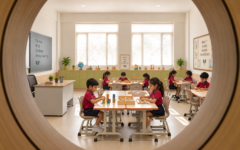
A school focused on the nursery-through-primary years, like Navriti, has a different advantage: the institution’s full attention is on the ages your child will be during their time there. The curriculum design, the training of teachers, the development of the physical environment — all of it is built for children from 3 to 11. For parents whose priority is getting the early and primary years right, this concentrated focus is worth considering.
Filter 3: Educational Philosophy 🎯
This is the filter most parents skip, and the one that matters most for day-to-day satisfaction with a school choice.
Gurgaon’s CBSE schools sit on a spectrum between two broad orientations. At one end: structured, academically intensive schools that use direct instruction, regular formal assessment, and a homework-heavy approach to primary education. These schools produce strong examination results and suit children who are academically confident and comfortable with formal demands. At the other end: schools with more exploratory, child-led approaches in the early years that emphasise conceptual understanding over content coverage, and which use informal assessment over formal testing. These schools suit children who learn through doing, who need space to think at their own pace, and whose curiosity is their primary learning engine.
Neither orientation is inherently superior. What matters is whether it matches your child. The mistake most parents make is not thinking about this explicitly — they visit schools and respond to the one that feels most impressive, rather than the one that feels most right for their specific child.
Navriti’s approach sits clearly in the second category. The school’s curriculum — informed by its advisory board of researchers and aligned with NEP 2020 — prioritises conceptual understanding, experiential learning, and the development of independent thinking across both the Neev pre-primary and Navya primary programmes. This approach is explained in more detail here.
How to Use the Three Filters to Build Your Shortlist 🗂️
Apply the filters in order. First, rule out any school where the commute is genuinely unsustainable. This usually eliminates half the options without any other research. Second, decide whether age-range continuity or focused primary expertise matters more to your family. Third, have an honest conversation with your partner or yourself about which educational philosophy fits your child’s personality and learning style — and use that to narrow to two or three schools worth visiting.
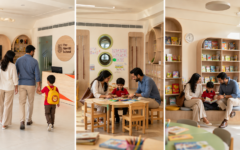
From that shortlist of two or three, book visits in July, August, or September. See each school on a live day. Ask the specific questions — about daily structure, about assessment, about how the school handles the range of learners in one class. And let what you observe matter more than what you’re told.
The Advantage of Starting Now
CBSE school applications for 2027–28 in Gurgaon will open in October or November. Parents who have built and visited a shortlist by then arrive at that window with a clear preference and the confidence that comes from having made an informed decision. Those who begin shortlisting in October make the same decision in a fraction of the time, with less information, and often with more doubt afterwards.
July is when the shortlist gets built. October is when the application gets submitted. The two months between are where the quality of the decision is made.
If Navriti is on your consideration list, register your interest for 2027–28 here and arrange a visit before the formal season opens.
Conclusion
Building a shortlist of CBSE schools in Gurgaon for 2027–28 doesn’t require a ranking table or a lengthy comparison spreadsheet. It requires three honest filters — commute, age range, and educational philosophy — applied in sequence. The schools that pass all three are the ones worth visiting. The one that feels most right when you visit is the one worth applying to.