What ‘Future-Ready’ Actually Means for a 7-Year-Old: Navriti’s Primary Approach
May 11, 2026 2026-08-20 8:08What ‘Future-Ready’ Actually Means for a 7-Year-Old: Navriti’s Primary Approach
What ‘Future-Ready’ Actually Means for a 7-Year-Old: Navriti’s Primary Approach
A seven-year-old who can solve complex math problems might struggle to ask for help when confused. Another child who memorizes facts perfectly may freeze when faced with an unexpected situation. What does being truly future-ready mean at this pivotal age?
Understanding what ‘future-ready’ actually means for a 7-year-old requires looking beyond academic achievements to the deeper skills that will serve children throughout their lives. At Navriti, this approach transforms how primary education nurtures young minds for an uncertain but exciting future.
Key Takeaways
• Future-ready skills at age 7 focus on curiosity, adaptability, and emotional resilience rather than just academic performance
• Confidence-building education through real-world experiences creates children who can navigate challenges independently
• Science-informed teaching recognizes that 7-year-old brains are uniquely wired for exploration and discovery
• Holistic child development balances cognitive growth with emotional intelligence and social skills
• Learning through discovery builds problem-solving abilities that traditional rote methods cannot match
The Real Meaning of Future-Ready at Seven
When parents hear “future-ready,” they often think of coding classes or advanced academics. But what ‘future-ready’ actually means for a 7-year-old centers on something far more fundamental: building the internal compass that guides lifelong learning.
At seven, children’s brains are experiencing remarkable growth. The science behind brain development shows this is when neural pathways for curiosity, resilience, and creative thinking become established. Future-ready education at this age means nurturing these pathways through experiential learning that feels like play but builds essential life skills.
Consider how a seven-year-old approaches a puzzle. They don’t just want the solution—they want to understand how the pieces fit together. This natural curiosity becomes the foundation for future innovation, but only if learning environments honor and expand it rather than rushing toward predetermined outcomes.
Core Elements of Navriti’s Future-Ready Primary Approach
Curiosity-Led Learning in Action 🔍
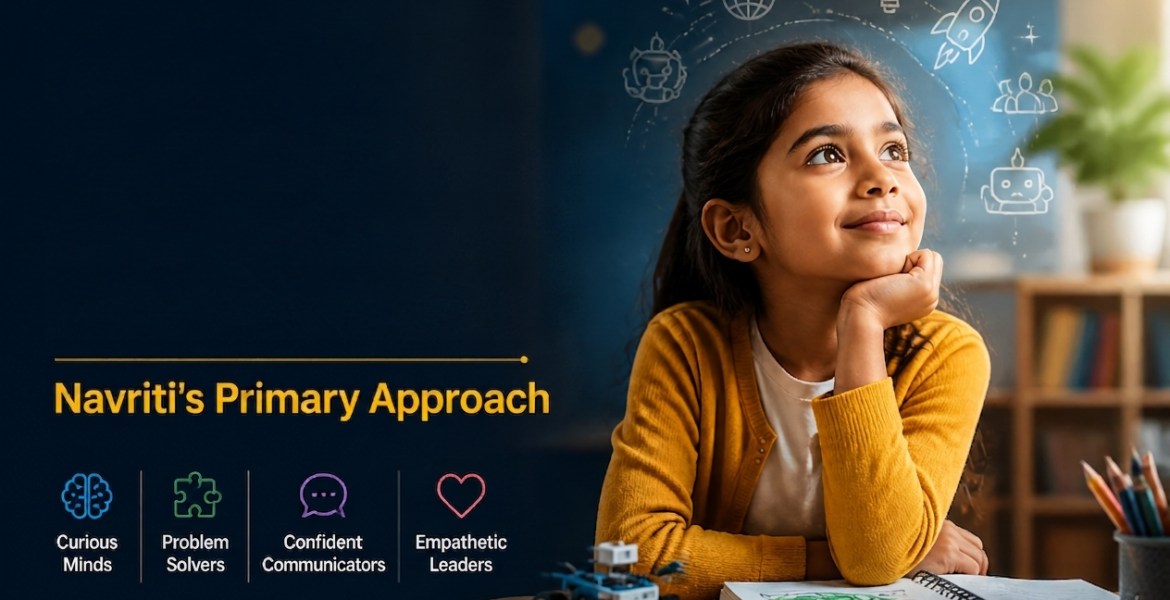
What ‘future-ready’ actually means for a 7-year-old at Navriti begins with following their natural questions. When a child wonders why leaves change color, this becomes a gateway to exploring seasons, plant biology, and even art through nature observation.
This approach recognizes that joyful classrooms produce deeper learning than stress-driven environments. Children who feel safe to wonder, experiment, and even fail develop the resilience that future challenges will demand.
Building Confidence Through Real Challenges
Seven-year-olds need opportunities to solve genuine problems, not just complete worksheets. Navriti’s approach includes:
- Project-based investigations that span multiple subjects naturally
- Collaborative problem-solving that builds communication skills
- Reflection practices that help children understand their own learning process
- Choice and agency in how they explore topics that interest them
Emotional Intelligence as Academic Foundation
The importance of emotional safety in learning cannot be overstated. Future-ready seven-year-olds need skills to:
- Recognize and name their emotions during challenging tasks
- Seek help when needed without feeling inadequate
- Celebrate others’ successes while building their own confidence
- Persist through difficulties with optimism and strategy
Beyond Traditional Metrics: What Actually Matters
The Power of ‘Not Yet’
In Navriti’s precision schooling approach, children learn that “I don’t know this yet” is more powerful than “I’m not good at this.” This growth mindset becomes the foundation for lifelong learning.
When a seven-year-old struggles with reading, future-ready education focuses on building phonemic awareness through games and songs rather than drilling sight words. The child develops both the skill and the confidence to tackle new challenges.
Real-World Learning Experiences 🌱
What ‘future-ready’ actually means for a 7-year-old includes connecting classroom learning to life beyond school. This might involve:
- Community connections where children interview local experts
- Nature-based learning that develops observation and inquiry skills
- Creative expression through multiple mediums and formats
- Physical movement that supports cognitive development
The Science Behind Age-Appropriate Future-Readiness
How Seven-Year-Old Brains Learn Best
Research in neuroscience and education reveals that seven-year-olds process information differently than older children. Their brains are primed for:
- Multi-sensory experiences that engage multiple learning pathways
- Story-based learning that helps organize and remember information
- Social learning through interaction and collaboration
- Movement-integrated lessons that support memory formation
Building Neural Networks for Future Success
What ‘future-ready’ actually means for a 7-year-old involves strengthening the brain’s executive function networks. These include:
- Working memory through engaging, multi-step activities
- Flexible thinking by exploring problems from multiple angles
- Inhibitory control through mindfulness and reflection practices
Practical Applications in Daily Learning
Morning Investigations
Each day might begin with a question that emerged from previous learning. “Why do some materials float while others sink?” becomes an opportunity to explore density, design thinking, and scientific method—all through hands-on experimentation that feels like discovery rather than instruction.
Integrated Project Work
When studying communities, children might design their ideal neighborhood, research different cultures, write stories about community helpers, and create mathematical surveys about family preferences. This 360-degree learning approach builds connections across subjects naturally.
Reflection and Growth
Future-ready seven-year-olds learn to articulate their thinking. “What did you notice? What surprised you? What would you try differently?” These questions develop metacognition—thinking about thinking—that serves learners throughout life.
Supporting Future-Ready Development at Home
Parents play a crucial role in reinforcing what ‘future-ready’ actually means for a 7-year-old. Simple practices include:
- Asking open-ended questions about daily experiences
- Encouraging experimentation in cooking, building, or creating
- Modeling curiosity by wondering aloud about everyday phenomena
- Celebrating effort and process rather than just outcomes
The goal isn’t to accelerate academic content but to deepen the thinking skills that make all future learning possible.
Conclusion
What ‘future-ready’ actually means for a 7-year-old extends far beyond academic acceleration or technology skills. It means nurturing the curiosity, confidence, and resilience that will serve children regardless of how the world changes.
At Navriti, this understanding shapes every interaction, every lesson design, and every assessment practice. The result? Children who approach challenges with excitement rather than anxiety, who see learning as discovery rather than performance, and who develop the internal resources to thrive in an unpredictable future.
For parents considering primary school options in Gurgaon, the question isn’t whether a school prepares children for tests—it’s whether it prepares them for life. Future-ready education at seven builds the foundation for everything that follows.
Ready to explore how Navriti’s approach could nurture your child’s future-ready development? Visit our campus to see curiosity-led learning in action and discover what truly matters in primary education.