
Artificial Intelligence and Human Evolution: Learning to Evolve with Technology
May 6, 2026 2026-08-20 8:08Artificial Intelligence and Human Evolution: Learning to Evolve with Technology
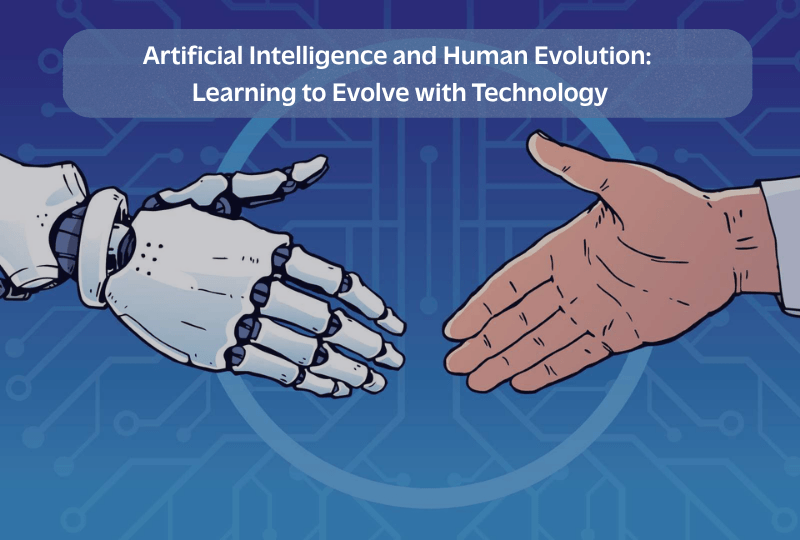
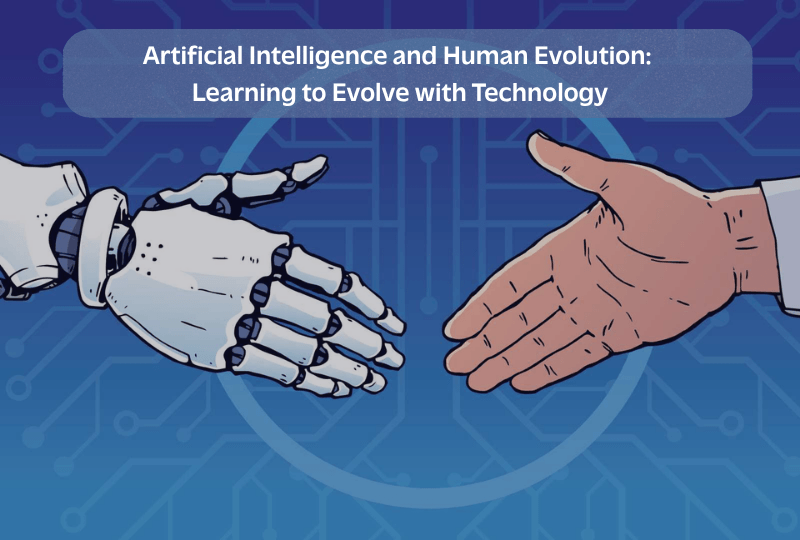
Artificial Intelligence and Human Evolution: Learning to Evolve with Technology
There is one word on almost everyone’s mind nowadays, an easy conversation starter. Your routinely doomscrolling might include animals, vegetables dancing funny or even new born babies talking like adults. Perhaps by now it has crossed your mind already, we’re talking about AI, short for Artificial Intelligence.
Gaining much popularity after ChatGPT was introduced, the origins of Artificial Intelligence can be traced back to World War II. For instance, during World War II (1939-1945), the Nazi Germany’s military command used a specialised device to communicate with their soldiers via discrete encrypted messages – this machine was called the Enigma. Considered to be unbreakable, this Enigma code was cracked by Alan Turing, a British Mathematician’s electro-mechanical ‘Bombe Machine’, helping shorten the war significantly. This marked a significant milestone in the history of computing and AI, laying the foundation for the development of modern computers.

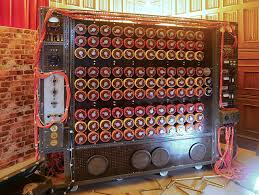
Images of the Enigma (left) & Bombe Machine (Right)
In 1955, John McCarthy gave this unknown field at the time its term, “Artificial Intelligence”. An umbrella term for the ability of computers to perform higher order tasks, mimicking human intelligence. Since then, it has evolved significantly from its early roots in systems like the Enigma Machine and the Bombe. It comprises Machine Learning, Deep Learning, Language Processing & Robotics. With advances in all the individual fields, it has emerged as a powerful tool capable of addressing complex challenges across fields such as healthcare, finance, transportation and more.
Amidst all of this, lies the job insecurity for this evolving world. With AI and its advancement it is believed it will be a matter of few more years when AI replaces humans in fields which are unimaginable in today’s time. AI excels in data driven tasks, providing speed in processing large amounts of data. If the British had to crack the Enigma Code today with the help of AI, it would have not taken years but a few seconds.
On the other hand, humans excel in contextual understanding, emotional intelligence & creativity. For us to evolve together and work out our future with AI we need to focus on what is called augmented learning – focusing on AI-human partnerships enhancing our capabilities rather than replacing them with AI.
We use AI for data heavy tasks and leverage its speed, while providing context, ethical judgement and insightful content using the power of our Brain. This collaborative approach is helping transform fields like healthcare, education and creative work.
Knowing the importance of augmented learning, The Navriti School strikes a thoughtful balance between embracing technology and ensuring that the human mind does not become overly dependent on it. Our curriculum is designed around 21st-century competencies, including digital citizenship, design and technology, and ethical thinking. Through initiatives such as the AI & Robotics Club, Digital Wellness Programme, and Innovation & Exploration Hub, we foster digital literacy and critical thinking from an early stage, empowering students to use technology responsibly and meaningfully.
Hence, evolution is the survival of life, and to thrive in a world increasingly driven by AI, we must learn to evolve with it.
—————————————————————————————————————–
Written by Kangna Verma, Admission & Communication Specialist, The Navriti School
Further Reading :
- Human Brain vs AI : what makes better decisions?
- Awakening the Machine : Tracing the origins and Evolution of Artificial Intelligence
- Human- versus Artificial Intelligence
- Could humans and AI become a new evolutionary individual?
- The Evolution and Future of Artificial Intelligence: A Student’s Guide