Progressive Schools in Gurgaon: What the Term Means and What to Look For in 2027-28
August 17, 2026 2026-08-20 10:56Progressive Schools in Gurgaon: What the Term Means and What to Look For in 2027-28
Progressive Schools in Gurgaon: What the Term Means and What to Look For in 2027-28
Nearly 65% of the jobs that today’s nursery students will hold in the future do not even exist yet. In a world moving at this speed, the traditional model of memorizing facts for a Friday test feels less like an education and more like a relic. Parents in Gurgaon are increasingly looking past the gleaming glass facades of school buildings to find something deeper: a “progressive” education. But as the term becomes a popular buzzword in admission brochures for the 2027-28 cycle, it is essential to understand what it actually looks like in a child’s daily life.
Progressive education isn’t just about modern architecture or tablets in every hand. It is a philosophy that views children as active participants in their own learning rather than passive recipients of information. It is about moving from “what to think” to “how to think.”
Key Takeaways
- Curiosity Over Rote: Progressive schools prioritize learning through discovery rather than repetitive memorization.
- Emotional Safety: A core tenet is creating an environment where children feel safe to take risks and make mistakes.
- Future-Ready Skills: The focus is on developing critical thinking, empathy, and adaptability for a 2026 and beyond world.
- Scientist-Informed Design: The best progressive environments use research to shape how children interact with their surroundings.
Defining Progressive Schools in Gurgaon: What the Term Means and What to Look For in 2027-28
At its heart, a progressive school is a laboratory for life. If you walk into a traditional classroom, you might see rows of desks facing a teacher who holds all the answers. In a progressive setting, the “classroom” is often a flexible space where the teacher acts as a guide or a co-researcher.
In the context of Progressive Schools in Gurgaon: What the Term Means and What to Look For in 2027-28, the term “progressive” implies a commitment to holistic child development. This means the school values a child’s emotional intelligence and social confidence just as much as their ability to solve a math problem.
Think of it like a garden. A traditional school might try to force every plant to grow to the same height at the same time using the same fertilizer. A progressive school understands that a rose needs different care than a sunflower, and that the goal is for each to bloom in its own season. This approach relies on science-informed teaching, where educators understand how the developing brain actually absorbs and retains information. When learning is joyful and relevant, the “bridge” between different parts of the brain strengthens, leading to deeper science-based memory retention.
The Essential Pillars of a Progressive Education
When evaluating schools for the upcoming academic year, it helps to look for these three foundational pillars. They differentiate a truly innovative institution from one that is merely “modern” in name.
1. Curiosity-Led Learning
In a progressive environment, questions are more important than answers. Instead of reading about gravity from a textbook, children might spend the morning dropping different objects from various heights and recording the results. This experiential learning ensures that the concepts “stick” because the child has lived them.
2. Emotionally Safe Learning Environments
Children cannot learn when they are anxious. Progressive schools invest heavily in the social-emotional well-being of their students. This isn’t just about being “nice”; it is about building confidence-building education models where a child feels brave enough to say, “I don’t understand” or “I have a different idea.”
3. Real-World Learning Experiences
Education should not be a bubble. A progressive school brings the world into the classroom and takes the classroom into the world. Whether it’s understanding sustainability by managing a school compost heap or learning math through a mock grocery store, the goal is real-world learning.
| Feature | Traditional Schooling | Progressive Schooling |
|---|---|---|
| Primary Goal | Exam performance | Deep understanding & growth |
| Teacher’s Role | Authority figure / Lecturer | Facilitator / Mentor |
| Student’s Role | Passive listener | Active explorer |
| Assessment | Standardized tests | Portfolios and observations |
| Environment | Rigid and desk-oriented | Flexible and movement-friendly |
How to Evaluate Progressive Schools in Gurgaon for 2027-28
As you begin your nursery admissions 2027-28 journey, the brochures can start to look very similar. To find the right fit, you need to look at the “micro-moments” during your campus visit.
Watch the Interaction
Observe how teachers speak to the children. Is there a sense of mutual respect? Do the teachers crouch down to the child’s eye level? In a progressive school in Gurgaon, the relationship is the foundation of all learning. You are looking for nurturing young minds in action, not just a teacher managing a room.
Ask About the “Why”
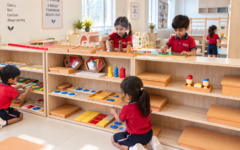
When a school shows you a sophisticated lab or a playground, ask them how it serves the child’s development. A scientist-designed school will be able to explain the research behind their choice of colors, the height of the shelves, and the lack of plastic toys. Every element should have a purpose rooted in child psychology and neurobiology.
Look for Documentation of Learning
In a progressive school, you might not see many worksheets with gold stars. Instead, look for “documentation”, photos of children mid-project, drawings with the child’s own words transcribed below them, and messy, wonderful evidence of learning through discovery. This shows that the school values the process of learning, not just the final product.
The Shift Toward 2027-28: What is Changing?
By the time the 2027-28 session begins, the gap between traditional and progressive schools will likely widen. We are seeing a significant shift in what parents prioritize. There is a growing realization that education beyond exams is the only way to prepare children for an AI-integrated future.
The focus is moving toward:
- Precision Schooling: Tailoring the pace of learning to the individual child rather than the average of the class.
- Soft Skills as Hard Skills: Empathy, collaboration, and resilience are being treated with the same academic rigor as literacy and numeracy.
- Screen-Wise Learning: Moving away from passive screen time toward using technology as a creative tool, while maintaining healthy physical engagement.
Conclusion: Making the Right Choice for Your Child
Choosing a school is one of the most significant decisions you will make for your child’s early years. While it is tempting to follow the crowd or choose the most famous name, the best school is the one that aligns with your family’s values and your child’s unique spirit.
A progressive school in Gurgaon for the 2027-28 session should feel like a community. It should be a place where your child’s curiosity is protected, where their confidence is built through genuine achievement, and where they are seen for who they are, not just what they can produce on a test.
As you shortlist schools for the upcoming cycle, take a moment to reflect: what kind of human being do you want your child to be at age 18? If the answer involves terms like “creative,” “compassionate,” and “resilient,” then a progressive, science-informed education might be the most meaningful gift you can give them.
Next Steps for Parents:
- Schedule a Visit: Websites can only tell you so much. Feel the energy of the “joyful classrooms” in person.
- Talk to the Educators: Ask about their philosophy on mistakes and conflict resolution.
- Observe the Students: Do they look engaged? Are they talking to each other, or just waiting for instructions?
- Trust Your Intuition: You know your child best. Choose the environment where you can see them truly thriving.