The Parent’s Guide to How Young Children Actually Learn: What Research Says (and What Schools Often Miss)
August 21, 2026 2026-08-20 11:28The Parent’s Guide to How Young Children Actually Learn: What Research Says (and What Schools Often Miss)
The Parent’s Guide to How Young Children Actually Learn: What Research Says (and What Schools Often Miss)
The human brain doubles in size during the first year of life and reaches about 90% of its adult volume by age five. This isn’t just a biological milestone; it is the most explosive period of learning your child will ever experience. Yet, in many traditional classrooms, this window of opportunity is spent sitting still, silenced by rows of desks and repetitive worksheets.
When we look at how children learn early years Gurgaon families often find themselves at a crossroads. Should education be about memorizing the alphabet by age three, or is there something deeper happening beneath the surface? As we navigate 2026, the science of learning tells us that children aren’t empty vessels to be filled with facts; they are tiny scientists, wired to experiment, fail, and try again.
Key Takeaways
- Learning is a social and emotional process; a child who feels unsafe or pressured cannot absorb new information effectively.
- The “play vs. academics” debate is a false dichotomy; high-quality play is the most rigorous form of early childhood learning.
- Neuroplasticity is highest in the early years, meaning experiences, not just instructions, shape the physical structure of the brain.
- Future-ready skills like critical thinking and empathy are built through discovery, not rote memorization.
The Science of the “Sticky” Brain: How Discovery Trumps Memory
For decades, many schools operated on the “industrial model”, the idea that if a teacher repeats a fact often enough, it will eventually stick. However, modern research into The Parent’s Guide to How Young Children Actually Learn: What Research Says (and What Schools Often Miss) reveals that the brain is far more selective. It prioritizes information that is connected to emotion, sensory input, and personal relevance.
When a child sits and traces the letter ‘A’ fifty times, they are learning fine motor control, but they aren’t necessarily learning the essence of language. Compare this to a child who “discovers” the letter ‘A’ while trying to write a sign for their pretend grocery store. In the second scenario, the brain creates a “sticky” memory because the learning was driven by a need to communicate. This is what we call learning through discovery.
Why Experience Beats Instruction
Research shows that active engagement, where a child is physically moving, touching, or deciding what happens next, leads to deeper neural connections.
| Feature | Traditional Rote Learning | Science-Informed Discovery |
|---|---|---|
| Child’s Role | Passive listener | Active investigator |
| Focus | Correct answers | The process of “how” |
| Retention | Short-term (for tests) | Long-term (conceptual) |
| Motivation | External (grades/stickers) | Internal (curiosity) |
In a science-informed teaching environment, the goal isn’t just to get the answer right. It is to understand why the answer matters. When children are allowed to experiment, they develop future-ready skills that go far beyond any exam.
What Schools Often Miss: The Emotional Engine of Learning
One of the biggest gaps in traditional education is the separation of “academics” from “emotions.” We often treat the brain like a computer, but it is actually more like a garden. If the soil (the emotional environment) is acidic or dry, nothing will grow, no matter how good the seeds (the curriculum) are.
Current research emphasizes that emotionally safe learning environments are a prerequisite for cognitive growth. When a child is stressed, their brain enters “survival mode,” redirecting energy away from the prefrontal cortex, the area responsible for logic and learning, and toward the amygdala.
Does your child feel safe enough to ask a “silly” question? Are they encouraged to try a solution that might fail? Schools that focus solely on metrics often miss the fact that confidence-building education is what actually enables high academic performance later in life.
The Myth of the “Early Start” in Rote Academics
There is a common misconception that the earlier a child starts formal, desk-based schooling, the further ahead they will be. In reality, the opposite is often true. Studies in developmental psychology suggest that pushing formal academics too early can lead to “burnout” by age eight or nine.
Instead, the how children learn early years Gurgaon parents should look for involves experiential learning. This includes:
- Building blocks: Learning physics, balance, and spatial reasoning.
- Group games: Developing social intelligence and collaboration.
- Storytelling: Building a rich vocabulary and emotional empathy.
When we prioritize holistic child development, we aren’t “delaying” learning. We are building the massive foundation required to support a very tall building.
How to Spot a Research-Informed Classroom
As a parent, how can you tell if a school understands The Parent’s Guide to How Young Children Actually Learn: What Research Says (and What Schools Often Miss)? It usually isn’t in the shiny brochures; it’s in the small details of the classroom.
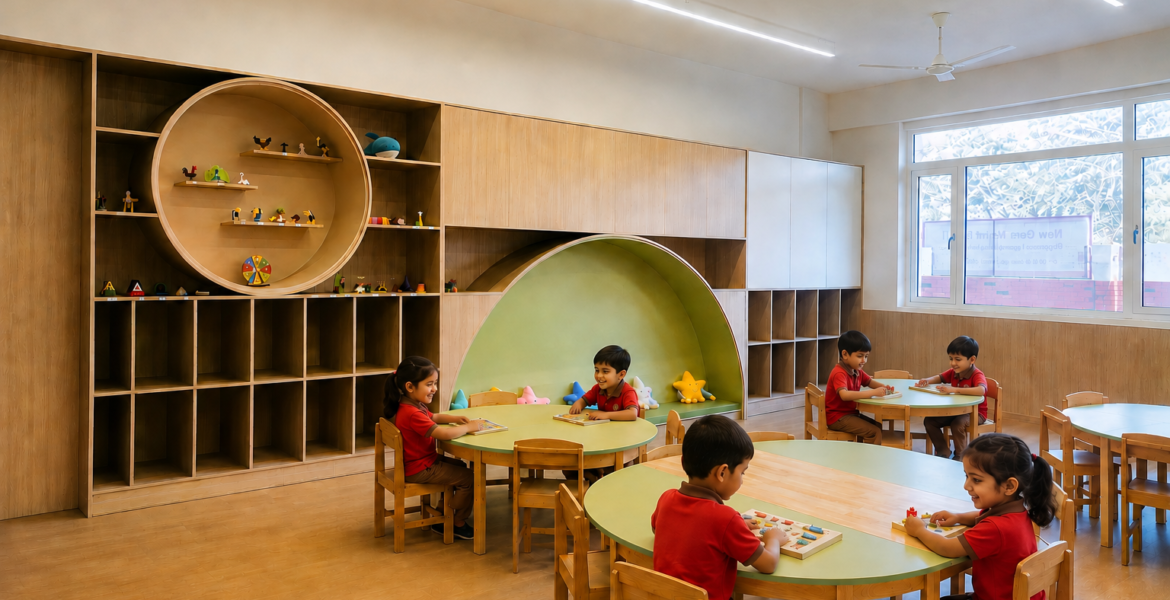
- Noise Levels: Is the room pin-drop silent, or is there a “busy hum” of children discussing projects? Learning is rarely quiet.
- The Walls: Are the walls covered in identical, teacher-made posters, or is the children’s own messy, creative work on display?
- The Questions: Does the teacher ask “What is the answer?” or “What do you think would happen if…?”
- Movement: Are children tethered to chairs, or are they encouraged to move as they explore different learning stations?
Choosing the best school in Gurgaon for your child in 2026 means looking for a place where curiosity-led learning is the heartbeat of every lesson.
“The goal of early childhood education should be to activate the child’s own natural desire to learn, not to force-feed facts that have no context in their world.”
Actionable Steps for Thoughtful Parents
Understanding the science of learning allows you to support your child’s growth both at home and when selecting a school. Here are a few ways to bring these research-informed principles into your daily life:
- Follow their lead: If your child is fascinated by shadows, spend the afternoon “chasing” them instead of sticking to a pre-planned activity. This validates their curiosity.
- Focus on the struggle: When your child finds a puzzle difficult, praise their persistence rather than their intelligence. This builds a “growth mindset.”
- Create a “Yes” space: Set up a small area in your home where your child can explore materials (clay, water, paper) without worrying about making a mess.
- Ask for the ‘Why’ during admissions: When visiting schools, ask how they handle a child who is struggling with a concept. Do they provide more worksheets, or do they find a new way to experience the idea?
Conclusion
The journey of The Parent’s Guide to How Young Children Actually Learn: What Research Says (and What Schools Often Miss) reminds us that the early years are not a race to the finish line. They are the time to dig deep roots. While traditional systems may still lean on the safety of rote learning and exams, the world our children will enter in the 2030s and beyond demands something different.
It demands people who know how to ask the right questions, who can work with others, and who haven’t had their natural curiosity schooled out of them. By choosing a nurturing young minds approach today, you are giving your child the greatest gift possible: a lifelong love for learning and the confidence to navigate an ever-changing world.