School Visit Checklist for Gurgaon Parents: 12 Things to Observe Before You Apply for 2027-28
August 6, 2026 2026-08-20 8:08School Visit Checklist for Gurgaon Parents: 12 Things to Observe Before You Apply for 2027-28
School Visit Checklist for Gurgaon Parents: 12 Things to Observe Before You Apply for 2027-28
While most parents in Gurgaon focus on the gleam of a new building or the height of a trophy cabinet, the most important data points in a school are often the ones that cannot be measured by a ruler. In a city where education is rapidly evolving, choosing a school for the 2027-28 academic year requires looking past the shiny brochures. The true heart of a school is found in the quiet hum of a classroom, the way a teacher kneels to speak to a child, and the spark of curiosity in a student’s eyes.
As you begin your journey of nursery admissions for 2027-28, remember that you aren’t just choosing a curriculum; you are choosing a community that will shape your child’s emotional and intellectual foundation. This School Visit Checklist for Gurgaon Parents: 12 Things to Observe Before You Apply for 2027-28 is designed to help you see beyond the surface and identify a learning environment where your child will truly flourish.
Key Takeaways
- Observe the Culture: Focus on the “vibe” of the school, are the children happy, heard, and actively engaged?
- Look for Science-Informed Practices: Ensure the school uses research-based methods rather than outdated rote learning.
- Safety and Emotional Well-being: Prioritize environments that feel both physically and emotionally safe for young learners.
- Future-Ready Skills: Look for evidence of future-ready education such as critical thinking, collaboration, and emotional intelligence.
Using Your School Visit Checklist for Gurgaon Parents: 12 Things to Observe Before You Apply for 2027-28
A campus visit is a rare window into the daily life of a school. It is your chance to move from theory to experience. As you walk through the halls of various CBSE schools in Gurgaon, use these twelve observation points to guide your reflection.
1. The Energy of the Classroom
Walk past a few classrooms. Is the air filled with the quiet, rigid silence of “discipline,” or is there a productive, joyful hum? In joyful classrooms, children are active participants. Look for students who are talking to each other, moving around to gather materials, and appearing genuinely absorbed in their tasks.
2. Teacher-Student Dynamics
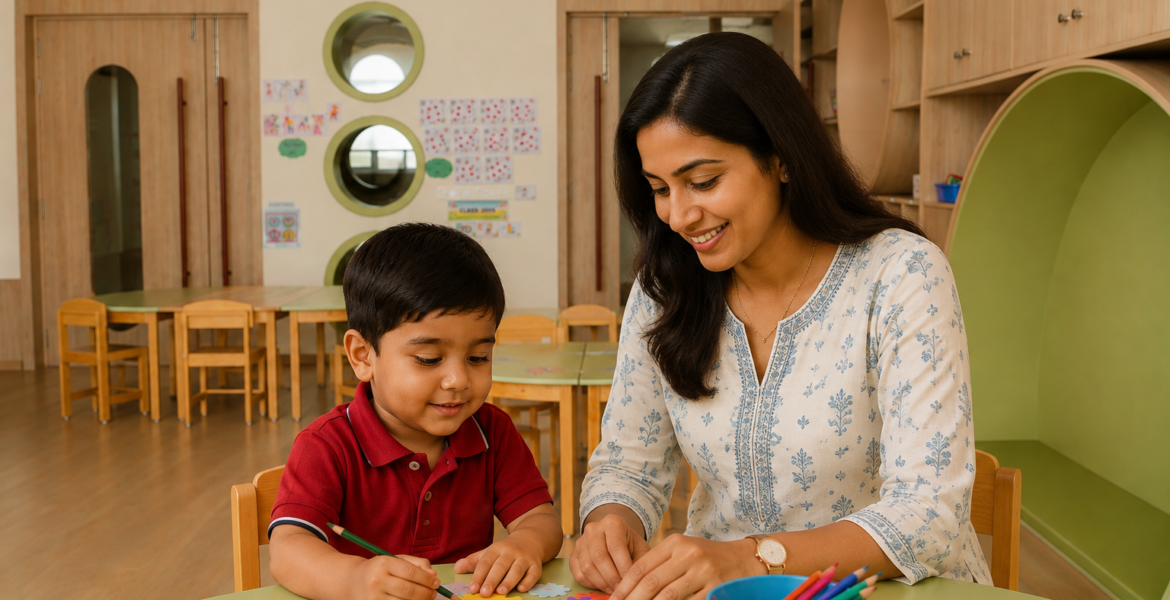
How do the adults interact with the children? Observe if teachers get down to the child’s eye level when speaking. Are they barked at with commands, or guided with questions? A science-informed teaching approach recognizes that children learn best when they feel respected and emotionally safe.
3. The “Walls” Speak
Look at the displays in the hallways and classrooms. Are they perfect, teacher-made posters? Or is it raw, authentic student work? Real learning through discovery is often messy. You want to see drawings, half-finished projects, and messy handwriting that shows the child’s actual journey, not just a polished final result.
4. Curiosity-Led Learning in Action
Ask to see where the “questions” go. Does the school have a way to capture what children are curious about? Look for “wonder walls” or project-based learning areas. A school that values curiosity-led learning will have spaces that encourage children to ask “why” and “how” rather than just “what.”
5. Social and Emotional Safety
An emotionally safe learning environment is one where a child feels comfortable making a mistake. Observe how a teacher handles a spill or a minor conflict between students. Are these moments used as opportunities for growth and empathy, or are they met with frustration?
6. Physical Layout and Accessibility
Is the furniture child-sized? Can children reach the books and materials themselves? A school designed for holistic child development empowers children to be independent. If everything is locked away or out of reach, the message to the child is that they need an adult’s permission to learn.
7. Natural Light and Greenery
Science tells us that natural light and connection to nature improve focus and reduce stress. Does the school feel like a corporate office, or does it breathe? Look for learning spaces that incorporate greenery and allow for plenty of sunshine.
8. Play as a Priority
In the early years, play is the most serious form of work. Observe the outdoor and indoor play areas. Are they just for “burning off energy,” or is there evidence of experiential learning through sensory play, building, and imaginative role-play?
9. Evidence of Real-World Learning
Does the school connect lessons to the outside world? Look for gardens, “maker spaces,” or community projects. You want a school that provides real-world learning experiences which help children see the relevance of what they are studying.
10. Inclusion and Diversity
Does the school reflect the world we live in? Observe how diverse needs are handled. A school that values every child’s unique path is more likely to provide a confidence-building education that celebrates individual strengths.
11. Technology as a Tool, Not a Gimmick
In Gurgaon, it’s easy to be dazzled by “smart” classrooms. However, observe how technology is used. Is it a digital replacement for a blackboard, or is it used for AI-powered learning and creation? Technology should enhance human connection, not replace it.
12. The “Gut” Feeling
As a parent, your intuition is a powerful tool. After the tour, sit in your car for a moment and reflect. Did the school feel like a place where your child would be known, loved, and challenged? Does it align with your family’s values for education beyond exams?
Going Deeper: Questions to Ask During Your Visit
While your eyes will tell you much, a few targeted questions can reveal the school’s underlying philosophy. When you meet the admissions team or the head of school, consider asking:
- “How does the school handle a child who is struggling emotionally on a given day?”
- “Can you give an example of how a teacher followed a student’s interest to create a lesson?”
- “What does nurturing young minds look like in the context of your daily schedule?”
Why the 2027-28 Admissions Cycle Requires a Different Approach
The world is changing faster than ever, and the skills our children need for the future, adaptability, empathy, and critical thinking, cannot be taught through a textbook. Gurgaon parents are increasingly moving away from “academic pressure cookers” and toward precision schooling and progressives models.
By using this School Visit Checklist for Gurgaon Parents: 12 Things to Observe Before You Apply for 2027-28, you are taking a scientific and heart-centered approach to one of the most important decisions of your life. You are looking for a partner in your child’s growth, one that understands that a child’s first school matters deeply for their long-term confidence.
Conclusion
A school visit is more than just a tour of a building; it is a search for a second home for your child. By focusing on teacher-student dynamics, the presence of joyful learning, and the school’s commitment to emotional safety, you can find a place that does more than just prepare your child for the next grade. You can find a school that prepares them for life.
As you finalize your shortlist for the 2027-28 session, trust your observations and your heart. Look for the spark. Look for the care. Look for the school that sees your child as the unique, capable individual they already are.
Next Steps for Thoughtful Parents:
- Download and Print: Keep this checklist handy for your upcoming visits.
- Schedule Early: Campus tours fill up quickly; book your visits at least 12-18 months in advance.
- Reflect Together: After each visit, discuss your observations with your partner or a trusted friend to gain different perspectives.
Use up and down arrow keys to resize the meta box pane.
Use up and down arrow keys to resize the meta box pane.
Use up and down arrow keys to resize the meta box pane.